February 18, 2026
Safety, Trust, and Affordability: The Real Costs of Federal Immigration Enforcement in Virginia
Families across Virginia should be able to go to work, study, and seek medical care without fear or intimidation. These basic freedoms are increasingly at risk as a result of more frequent encounters with federal law enforcement officials, who may often be masked and unidentifiable. Recent national and local incidents have shown that this very low bar and expectation of safety is harder to count on, particularly for immigrant families, people of color, and concerned bystanders.
While the federal government has pumped billions of dollars into federal law enforcement through H.R. 1, states are expected to backfill massive amounts of federal cuts to Medicaid and SNAP. The resulting rapid expansion of federal immigration enforcement — often involving undertrained personnel — increases the risk of harmful encounters for families and bystanders. These choices also shift costs onto local communities. State and local resources, including funding, law enforcement officers, and facilities, should remain focused on serving communities rather than assisting an already overfunded federal immigration enforcement operation whose practices have created dangerous encounters and violated people’s rights.
Cutting Health and Food Assistance, Splashing Cash on DHS
On July 4, 2025, President Trump signed H.R. 1 into law. This bill made sweeping cuts to the nation’s safety net programs: slashing $911 billion from Medicaid and $187 billion from SNAP food assistance, among other cuts. Some of these cuts directly target people lawfully residing in the U.S. because they sought safety or because returning to their native country was dangerous (refugees, asylees, and humanitarian parolees), removing their access to Medicaid, Medicare, subsidized ACA marketplace coverage, and SNAP. This is despite the fact that immigrants contribute to these systems through taxes and economic activity.
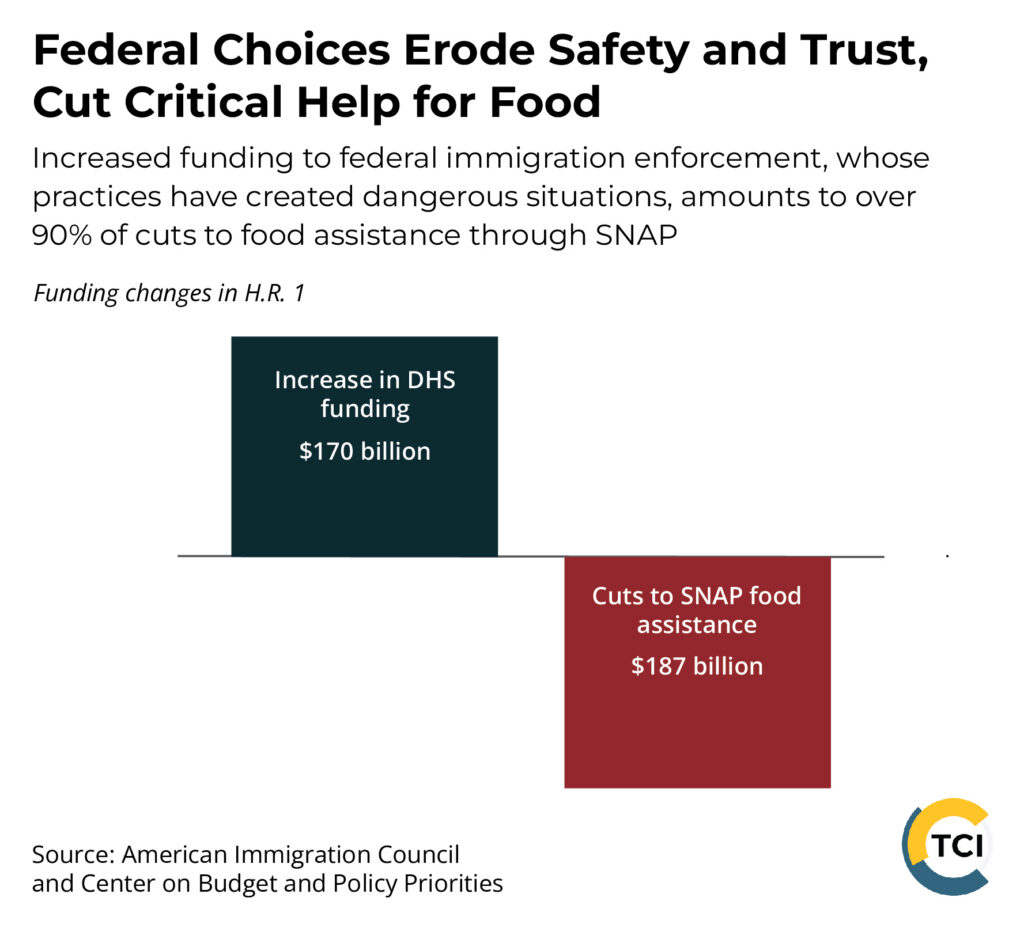
In contrast, H.R. 1 included $568 billion in tax cuts primarily benefiting wealthy individuals and corporations and over $170 billion in new funding for the Department of Homeland Security (DHS).
When considering the $170 billion increase in funding for border and immigration enforcement:
- $47 billion went to reinforcing and expanding the border wall
- $45 billion was allocated for family and adult detention
- $30 billion went to Immigration and Customs Enforcement (ICE)
What These Changes Mean For Virginia’s Budget and Communities
Federal decisions are expected to have direct consequences for Virginia’s budget and for the people and families who call the state home. Provisions in H.R. 1 increase state SNAP costs, which could amount to $311.4 million over the next two years. Medicaid changes will reduce support for Virginia hospitals and health facilities by $26 billion over the next fourteen years, including state-supported hospital systems run by VCU and UVA.
According to KFF, provisions in H.R. 1 are expected to increase the number of uninsured people in Virginia — taking away:
- Medicaid coverage from 260,000 people
- ACA Marketplace coverage from 38,000 people
- Medicare coverage from 12,000 people
When combined with the expiration of enhanced ACA subsidies, an estimated 350,000 people in Virginia will become newly uninsured due to federal decisions.
Changes to SNAP could reduce or eliminate food assistance for about 850,000 people and 445,000 families. When people can’t rely on these critical services, increased community need for free or affordable health services and food assistance rises, putting pressure on non-profits and localities already struggling to meet today’s needs.
At the same time, more than $30 billion in additional ICE funding allowed DHS to significantly expand the number of ICE officers available for surges across the country. On January 3, 2026, DHS announced that ICE had more than doubled its total number of officers and agents from 10,000 in 2025 to 22,000 in January 2026.
Across the nation, media reports have described ICE raids at or near previously protected locations like schools, hospitals, child care centers, and courthouses. There have also been documented incidents of masked and unidentified ICE agents apprehending individuals and escalating situations, including at least eight instances in 2026 that culminated in the loss of life at the hands of federal ICE agents or while in ICE custody. Such practices can discourage victims and witnesses from reporting crimes or seeking help, weakening community trust and public safety.

Local and State Agreements Erode Resources and Community Trust
An executive order from former Governor Youngkin entered several state agencies, including Virginia State Police and the Virginia Department of Corrections, into agreements with federal immigration enforcement agencies known as 287(g) agreements. Youngkin also encouraged localities to enter these agreements, which extend cooperation with ICE and allow certain state and local personnel to further civil immigration enforcement, and exist in several forms: Warrant Service Model, Jail Enforcement Model, and Task Force Model.
Under the Task Force Model, local and state employees act as independent federal immigration officers, applying immigration laws to their everyday interactions, with just 40 hours of online training. According to documents obtained by the Legal Aid Justice Center, as of the end of 2025, at least 223 state and local personnel were nominated to act as immigration enforcement, including two security resource officers embedded in public schools in Buckingham and Washington Counties and a behavioral health advocate in Washington County.
Thankfully, Governor Spanberger moved quickly to rescind Gov. Youngkin’s executive order and issued a directive to end any existing state-level 287(g) agreements. This decision is critical to beginning to repair trust in our communities.
Unfortunately, 27 local agreements remain in 25 Virginia localities as of February 9, 2025. These agreements divert local resources and officials from local community policing. The agreements erode community trust with law enforcement, making some immigrant communities less likely to report crimes and more vulnerable to being targeted by potential offenders.
Arrests at Virginia courthouses while individuals attempt to respond to minor traffic-related offenses, like charges related to vehicle inspection, registration, or tags, further erode trust. Notably, in the first seven months of the Trump administration’s immigration enforcement efforts, less than half (45%) of people arrested in Virginia by ICE officials had ever been convicted or accused of a crime.
At the same time, communities across the country have shown a different response: neighbors showing up for one another. In Minnesota, neighbors and communities organize monitoring networks, accompany each other to schools and courts, and provide mutual aid to families affected by enforcement activity. These examples show how community safety is strengthened — not by fear, but by collective trust and prioritizing community needs.
Next Steps for Virginia
Virginia lawmakers already face new budget challenges from federal cuts to safety net programs alongside increased federal spending on immigration enforcement. The Commonwealth should not respond by diverting resources away from essential services or weakening trust between communities and public institutions. Virginia families deserve to be able to work, study, and travel freely without fear of unnecessary interactions with masked and unidentified federal law enforcement officials
Gov. Spanberger took a strong and decisive step to remove state agencies from agreements that supported civil immigration enforcement. Legislation being considered in Virginia’s General Assembly would restrict or provide new guardrails on existing and any future local and state ICE agreements (HB1441 & SB783). Additional proposals aim to reduce civil immigration enforcement in sensitive locations (HB650), and would require state and federal law enforcement to clearly identify themselves and not be masked while working (HB1482 & SB352).
Virginia lawmakers can follow Gov. Spanberger’s lead by taking steps to prioritize safe and stable communities. A stronger future is one where families remain together, public institutions are trusted, and safety doesn’t depend on where you were born or the color of your skin.
Category:
Immigration