August 25, 2026
A Better Formula is Possible: Modeling K-12 Funding Options for Virginia
Every student in Virginia should have access to a great public school that has the resources they need to overcome challenges, learn, and grow into a thriving young adult. Yet in too many places, that’s not the case. Students, parents, teachers, and staff are working hard. Still, they don’t have the resources they need, whether that’s student mental health supports, training that helps teachers better serve multilingual learners in CTE and advanced coursework, or money for teacher and staff raises to make sure experienced educators can afford to keep teaching.
Virginia has an opportunity over the next two years to change that. As policymakers consider rewriting Virginia’s school funding formula into a simpler, more transparent student-based formula, they also have the opportunity to meaningfully improve educational opportunities in Virginia by increasing both the adequacy and equity of school funding. But there’s no guarantee that rewriting the formula will automatically improve funding for Virginia students. It will take engagement by students, parents, educators, and communities across Virginia to make sure policymakers know what students need in your community and why the status quo isn’t good enough.
To support these conversations, TCI created a new illustrative tool that lets anyone explore how different funding choices could affect state funding and your local school division.
Why We Need to Rethink School Funding
In 2023, Virginia’s research agency, JLARC, found that state funding falls short of what schools need to provide a high-quality education. JLARC also found that Virginia’s school funding formula fails to accurately reflect the costs of a high-quality, modern education, especially for students with disabilities, multilingual learners, and students from low-income families. While some local governments have the local resources to make up for the state’s shortcomings, other communities do not have the same capacity. Students in different parts of Virginia end up having access to very different levels of support and educational opportunity.
The state has made some progress in improving funding since JLARC’s 2023 report, but there’s still a long way to go. Because school funding affects everything from teacher pay to student support, improving both the adequacy and equity of school funding will make a big difference in student outcomes, particularly for students from low-income families.
One Option: A Student-Based Formula
JLARC also found that the current state funding formula is very complicated. One option that has received considerable attention is adopting a simpler, more transparent “student-based funding formula,” which JLARC noted most other states use. Virginia’s current formula, the Standards of Quality, attempts to estimate how many teachers and other staff are needed for each group of students, calculate salaries and benefits for each position, add extra costs for students with higher needs (although some of this is done outside the main SOQ formula), and combine those into a final funding amount. While comprehensive, it’s also complicated and doesn’t provide enough money for a high-quality education.
Under a “student-based” funding formula, the state would provide its share of:
- a base amount per student,
- additional funding (or “add-ons”) for a few groups of students who need more support to thrive, such as students from low-income families, multilingual learners, and students with disabilities, and
- some potential additional adjustments, including for regional differences in labor costs and the higher per-pupil costs faced by very small school divisions.
Overall, this approach would be much less complex and would provide local school divisions more flexibility in how they spend money to meet student needs.
Momentum for Change and Opportunity for Input
There’s momentum for change right now. Governor Spanberger and key legislative leaders have committed to taking action to address the 2023 JLARC findings, including embracing the “policy option” of switching to a student-based funding formula. In the spring of 2026, Virginia Secretary of Education Jeffrey Smith and State Superintendent Jenna Conway traveled across Virginia to hear directly from communities. Nearly 2,300 people, including at least 113 students, shared their experiences and provided insight into what is working in our schools and what needs to change. The state has published both a summary and detailed report of what people shared. And the General Assembly’s Joint Subcommittee on Elementary & Secondary Education Funding is charged with determining how to implement JLARC’s recommendations and whether to implement the policy options, including the student-based funding formula.
The outcome of these conversations is by no means pre-determined. Whether Virginia changes to a student-based funding formula — and whether that new formula makes Virginia’s school funding more adequate and equitable — will depend on who shows up and contributes their insights, time, and passion to the process.
The Type of Formula is Only Part of the Story
Simply changing to a student-based formula will not determine whether schools will have the resources students need to thrive. It all depends on how lawmakers design it.
As policymakers consider different approaches, they’ll face important questions:
- Will the formula provide enough funding for every student to succeed?
- Will it direct more resources to students who face the greatest barriers to learning?
- How much should the state invest overall?
Different answers to those questions will produce different outcomes for students and school divisions across Virginia. The decisions lawmakers make now will shape our students’ future. That is why families, educators, advocates, and community members need to stay engaged in the conversation and help keep those questions front and center.
Imagine and Explore the Possibilities
To help students, parents, educators, and policymakers imagine what different funding formula options could mean for their community, TCI has created an interactive model that compares student-based funding formula options to the state’s current funding formula. The model allows users to select the base amount and add-ons for students facing higher barriers to learning, then see how those choices affect state and local funding by school division. This simplified model is for illustrative purposes only and does not include other JLARC recommendations and options that could affect school funding, including changes to the local composite index and alternative geographic cost and economies-of-scale adjustments.
Here are a few examples of what different choices could mean:
Prioritizing students facing greater barriers
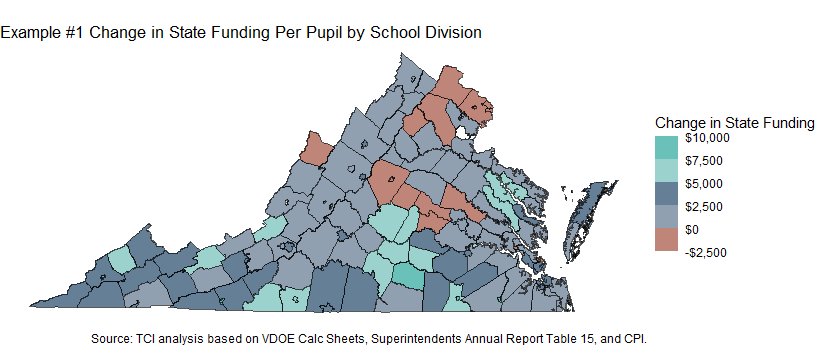
Setting a relatively low base amount per student and high add-ons could increase state funding for school divisions in the Middle Peninsula, Southside, and Southwest Virginia that have many students from low-income families while slightly reducing state funding for many school divisions in Northern Virginia. An example of this is shown in Map #1, using a set of options that would increase state funding overall by about $1.6 billion.1 Under this model, some local school divisions would have to contribute more than they currently do, while some already contribute more than would be required.
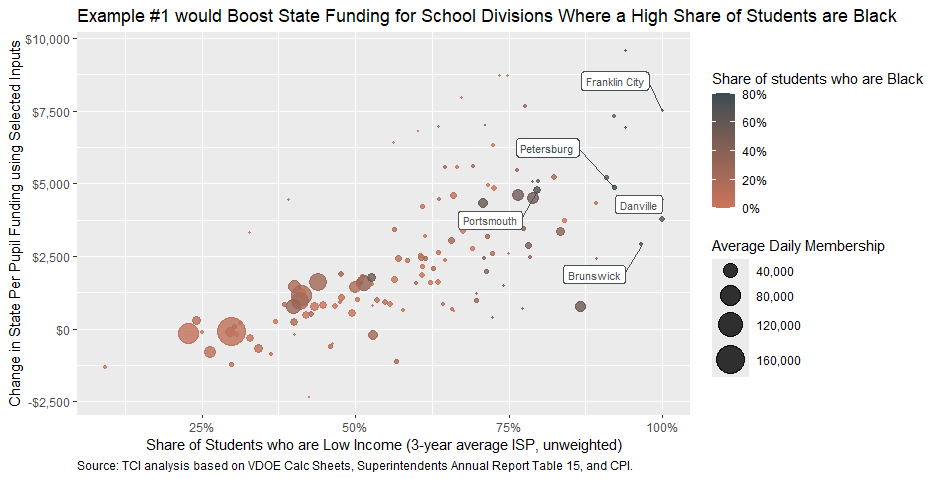
Because Virginia has a history of particularly underfunding schools serving many Black students, lawmakers must avoid unintentionally replicating that harm in the new funding formula. To help users examine that aspect, the model also shows how funding would vary based on the share of Black students enrolled in each local school division. Using the same inputs as in Map #1, school divisions serving larger shares of Black students would generally receive more state funding than they do today.
Spreading increased funding more evenly
Like the previous example, this scenario assumes a $1.6 billion increase in state funding. What changes is how the additional funding is distributed. If policymakers choose a slightly higher base funding amount while keeping Virginia’s add-ons for higher-needs students at the current, relatively low levels, the benefits of a funding formula overhaul would be more evenly distributed across the state, although there would continue to be some “winner” and “loser” school divisions.2

Making a larger investment to improve both adequacy and equity
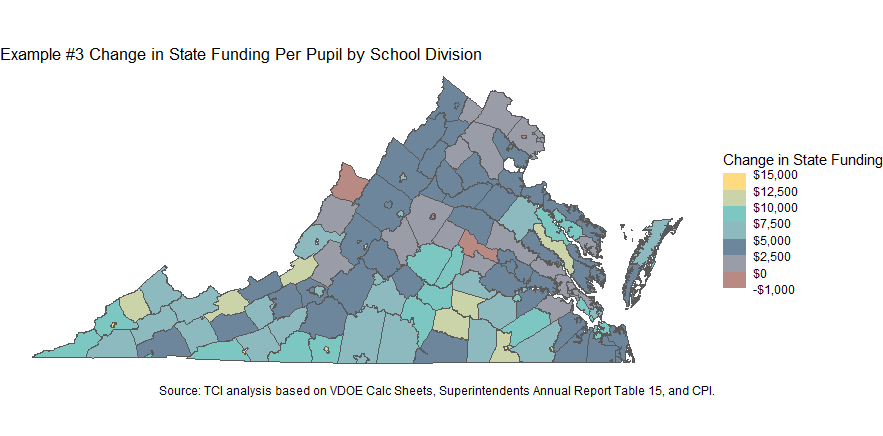
Of course, policymakers could take the opportunity of a funding formula overhaul to make a big difference on adequacy and equity by raising the base amount to a more adequate level and setting add-on levels for students facing higher barriers to the “best practices” that JLARC identified in its review of other states.3 Doing so would provide funding increases for more school divisions. While it would require about $4.2 billion in additional state resources each year compared to current funding levels, lawmakers have several options to raise new revenue while making our tax code more fair.
Explore for yourself
With TCI’s illustrative model, you can enter your own funding options to estimate what they would mean statewide and for your school division. The model uses the most recent data from the Virginia Department of Education. However, comparisons to current local spending rely on data that is a few years old. While we’ve adjusted that data for inflation, you may want to check your local budget documents to see how your model results compare to actual current local spending.
Getting Involved
Policymakers’ decisions over the next two years will shape public education and our students’ experiences for years to come. The Fund Our Schools Coalition is committed to advancing adequacy and equity in school funding by helping students, parents, educators, and communities across Virginia make their voices heard. You can sign up for occasional email updates and follow the coalition’s socials to stay informed of opportunities to get involved.
*If you explore the model and something doesn’t look right, let us know! For people who want to dig deeper, we’re happy to share the R code behind the model.
Model inputs
- Model results using base funding per pupil of $11,000, add-on for English language learners of 50%, add-on for students with disabilities of 90%, and an add-on for students from low-income families of 11% (base) and 80% (concentration). New state funding is $12,864,191,073, compared to current state funding of $11,235,469,761.
- Example #2 model results using base funding per pupil of $13,400, add-on for English language learners of 24%, add-on for students with disabilities of 48%, and an add-on for students from low-income families of 11% (base) and 38% (concentration). New state funding is $12,866,953,677, compared to current state funding of $11,235,469,761.
- Example 3 base funding of $13,400, ELL: 40%, SWD: 105%, at-risk base: 11%, at-risk concentration: 72%. New state funding is $15,428,152,108, compared to current state funding of $11,235,469,761.
