March 31, 2026
Senate Budget Invests More in Public Schools with Data Center Revenue
Improving public schools so that every child can learn and thrive is a top priority for Virginia families, and it receives a lot of attention from legislators each year. With budget negotiations still underway, there’s still an opportunity to make sure policymakers prioritize adequate and equitable support for students in the final deal, which we expect to be released shortly before the April 23 special session.
Both the House and Senate budget proposals do more for Virginia students than former Governor Youngkin’s introduced budget proposal. But the Senate budget provides the most overall resources, the most funding for school construction and modernization, and the most ongoing (versus one-time) support for public schools. This matters because ongoing funding gives school divisions the confidence to invest in staff and other long-term supports that help students learn.
Buoyed by new revenue from making data centers pay their fair share, the Senate provides $577 million more than the introduced budget proposal in direct aid distributions to local school divisions and sets aside $50 million for school construction and modernization loans (that $50 million is on top of the $577 million). Former Governor Youngkin proposed to eliminate funding for the loan program, but did retain the separate School Construction Fund grant program.
The $577 million includes:
- $221 million in additional flexible funding for school divisions from increased sales tax transfers – mostly from taxing data centers – and from dedicating skill games tax revenue to public schools,
- $193 million to pay the state’s share of boosting the annual salary increases for teachers and school staff from 2% proposed by former Governor Youngkin – which may not keep up with inflation – to 3% a year,
- $99 million to boost support for schools serving high concentrations of students from low-income families, who face significant barriers to learning and for whom research shows additional funding makes the most difference in boosting outcomes,
- $26 million to make a small boost in flexible support for students with disabilities and
- $5 million to help with developing and implementing community schools.
These strong investments are possible mainly because the Senate includes ongoing revenue from closing the data center tax loophole.

The House budget proposal provides an additional $549 million in distributions to local school divisions but reduces funding for school construction grants by $172 million compared to the governor’s introduced budget. Because the House did not propose closing the data center tax loophole, it has less ongoing revenue than the Senate budget. As a result, the House proposes that $400 million of that $549 million be one-time funding, which doesn’t allow school divisions to responsibly use it for anything with ongoing costs.
There is one area where the House budget is stronger: it includes an additional $148 million over the biennium to permanently boost flexible funding to help meet the needs of students with disabilities.
Over the next month, policymakers will decide which aspects of each budget to include in their compromise “conference report” that will be sent to Governor Spanberger for her amendments. A few things have already been decided in regular bill negotiations, including keeping tax revenue from skill games in the General Fund, rather than dedicating it to public schools as the Senate proposed. (Update 4/14/2026: On April 13, the governor vetoed the General Assembly’s bill (SB661) on skill games. Action could still be taken in the budget on this topic.)
But much remains to be decided, including whether the final budget will include the sustained revenue needed to make stronger investments in public schools. There’s still time to make your voice heard on sustained funding for public schools.
Interested in how all this impacts your local school division? Click the image below to get the details!
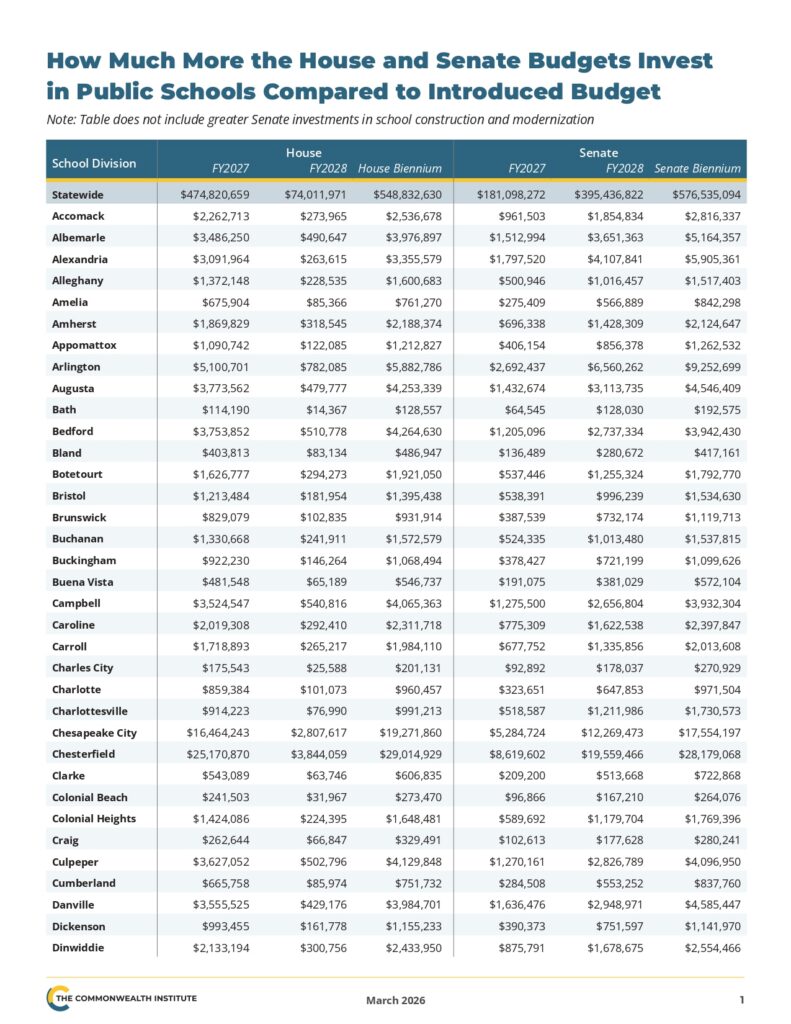
Note: Because school construction funding is awarded to school divisions through a competitive application process, it doesn’t show up in the school division direct aid distribution tables that accompany budget proposals. That means that, while the Senate budget has $222 million more for school construction and modernization than the House budget, the Senate and House direct aid formula distributions to local school divisions are relatively similar to each other.
Categories:
Budget & Revenue, Education
