August 11, 2026
Criminal Legal Reform in Virginia is Working. The State Should Count All the Savings
There has been real change in recent years to Virginia’s criminal legal system. Fewer people are behind bars, Virginia has the nation’s lowest rate of people reoffending, and crime continues to decline. Unfortunately, the state has not fully accounted for how much savings has been realized by reforming the system. Documenting the savings will allow for a better view into the full benefit of recent reforms and help lawmakers invest more in what works.
Reform is Working
Years of persistent advocacy have driven lawmakers to pass a series of reforms to influence who ends up behind bars, for how long, and under what circumstances. Since 2020, there have been several important policy decisions. The expanded earned sentence credit program gave people in prison a meaningful way to work toward earlier release. Raising the felony larceny threshold from $500 to $1,000 meant that one mistake was less likely to become a lifelong felony conviction. Jury sentencing reform ended a practice that for decades had pushed sentences well above what guidelines recommended. And changes to probation rules put limitations on re-incarcerating people for technical violations, such as missing an appointment, when they hadn’t committed new crimes.
The results are real, and they belong to real people. Thousands of parents are back home for bedtime routines, thousands of workers are back on the job, and thousands of neighbors are rebuilding lives that incarceration once put on hold. Those changes show up in the data. Virginia’s average daily prison population was reported to be 28,966 in the budget year that began July 2018 (fiscal year 2019) and fell to 23,325 in fiscal year 2025. DOC’s fiscal year 2019 number left out roughly 1,550 people held at Lawrenceville Correctional Center, a state-owned prison then run by a private company, while today’s count includes them. Counting the people at Lawrenceville in both years, the decline is more than 7,000 people.
At the same time, Virginia’s rate of people returning to prison after release fell to 17.6% — the lowest in the United States and the lowest in the commonwealth in more than 20 years. This is an improvement from the previous rate of 19%. Virginia has now had the lowest or second-lowest recidivism rate in the nation for 12 consecutive years.
A smaller prison system has not come at the cost of public safety. Virginia’s overall crime rate is lower today than it was a decade ago, driven by a roughly 16% drop in property crime between 2015 and 2024. Both violent and property crime fell in 2024.
These reforms are an important step toward unwinding the last 40 years of policy choices that fueled mass incarceration while doing little to nothing for public safety. Past policy decisions have overwhelmingly harmed Black Virginians, who are incarcerated at 4.1 times the rate of white Virginians and make up more than 54% of the state prison population. As a result, Black families and communities have carried the greatest burden of an oversized prison system. Shrinking that system — and fully accounting for what reforms save — can help Virginia invest more in the approaches that create safer communities, expand opportunity, and help more people thrive.

Reform has saved Virginia real money
Criminal legal reform has generated real savings for Virginia. Some changes are straightforward to measure, while others are harder to capture. Still, the savings that have been documented show what’s possible when fewer people are incarcerated.
The Department of Corrections’ (DOC) own financial reports show it cost an average of $47,555 per person to incarcerate someone in a Virginia prison in fiscal year 2025. But the savings math is not as simple as multiplying that figure by the number of people who come home. Many prison costs — staff, building, utilities, and administration — remain nearly the same whether it holds 800 or 600 people. DOC’s own reports acknowledge that as the prison population falls, the average cost per person rises since those fixed costs are spread across fewer people. For comparison, supervising that same person in the community, through probation or parole, costs about $2,094 in fiscal year 2025. The real savings happen when facilities close, and when they do, the numbers are significant.
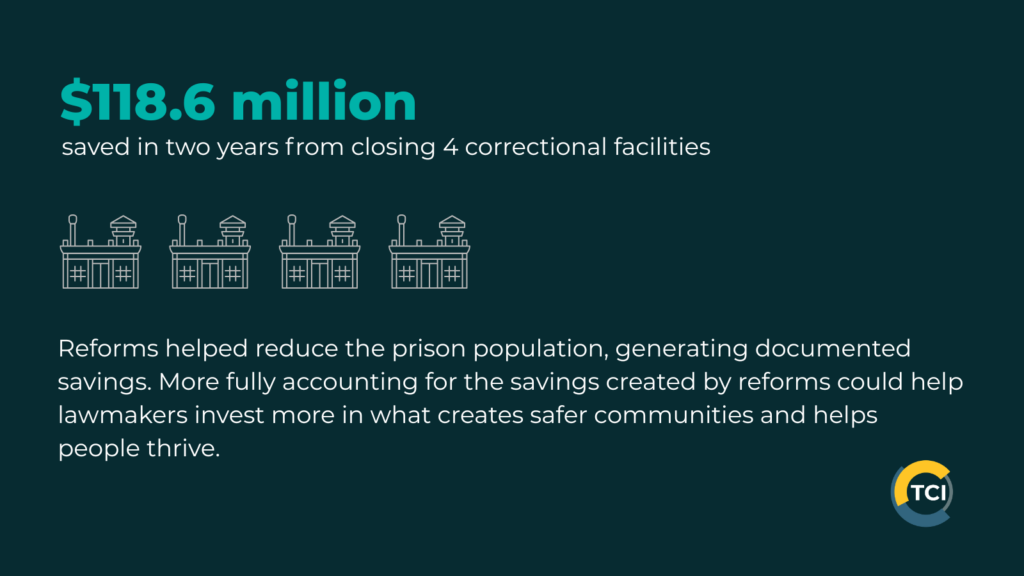
In June 2024, Virginia shut down four correctional facilities (Augusta Correctional Center, Sussex II State Prison, Haynesville Field Unit, and Stafford CCAP) as the prison population declined enough to make those closures possible. Virginia’s correctional population forecasts document exactly which legislation drove each wave of releases, including the retroactive expansion of earned sentence credits that allowed more than 2,600 people to return home in July and August 2022 alone. The General Assembly estimated those closures would save $118.6 million in the General Fund over two years, roughly $59 million a year in avoided costs for staff, utilities, maintenance, and operations. That is money the state documented in its own budget, and it is a direct and measurable result of reform.
The savings extend to local jails as well. For years, Virginia contracted with local and regional jails to house thousands of people sentenced to a year or more for a felony (also called a “state-responsible inmate”). As reforms reduced the overall corrections population, that number dropped sharply, from more than 3,000 people a day in March 2022 to about 416 a day on average in fiscal year 2023. The state budget documented $30 million in savings for two years from that reduction. The state pays localities $15 per day for each state-responsible person held locally, amounting to $5,475 per person per year. When state reforms result in fewer people held in local jails, those payments go down. Local governments could also benefit because housing state-responsible people costs far more than what the state reimburses. Actual jail operating costs averaged $151.38 per person per day in fiscal year 2024, and localities themselves contributed $691.8 million to their jails that year — an average of 57.6% of total jail expenditures, compared to the Commonwealth’s 36.4%. Documented savings from prison closures and reduced jail reimbursements represent just a portion of the fiscal benefits that criminal legal reforms have generated.
The prison population shrank. DOC’s budget didn’t
Criminal legal reform, along with early releases during the pandemic, has reduced Virginia’s prison population by more than 7,000 people since 2019, yet despite the savings from closing some facilities, the DOC’s overall budget has remained largely unchanged. Adjusted for inflation, DOC spending has stayed at about $1.6 billion, roughly where it was before the reforms. Security staff and facility operations alone account for $908 million, or 56.5% of spending. Add prison medical care and education, and the direct costs of keeping people in state custody make up 77% of everything DOC spends.
DOC’s budget and actual spending no longer align. Continued high budgets and costs for DOC are partly attributable to growing medical costs, driven by an aging population with more chronic illness and by rising costs for medical staff. In January 2026, the Senate Finance and Appropriations Committee’s budget staff reported that DOC’s inmate medical program exceeded its budget by $23.7 million in fiscal year 2025. The department largely covered those costs with savings from unfilled security jobs, where a 21% vacancy rate left millions unspent. The same staff wrote that “questions remain about the current allocation of DOC resources given recent inmate population trends” and recommended that the department “continue to examine its allocation of staffing, medical, and educational resources” as it develops future budget requests. Virginia has not yet fully accounted for what a smaller correctional system should cost.
Why the savings aren’t fully counted
Under Virginia Code §30-19.1:4, the Virginia Criminal Sentencing Commission is required to calculate the costs of legislation that increases the prison population. There is no equivalent requirement to estimate savings when reforms reduce incarceration. On every fiscal impact statement the Commission produces, it notes that its analyses “only include the estimated increase in operating costs associated with additional state-responsible prison beds and do not reflect any other costs or savings.”
This is not a flaw in how any one agency operates. It is a structural limitation in Virginia’s approach to measuring the fiscal impact of criminal legal policy. That same issue exists beyond prison beds. There is no requirement to estimate savings when reforms reduce the number of people held in local jails pretrial, lower fines and fees burdens, or reduce probation violations. While these savings are sometimes acknowledged, they are not typically quantified. And some of the costs attributed to reforms are not new costs. A person released earlier through earned sentence credits may need reentry services or probation supervision sooner, but they would have needed it eventually. The reform changes the timing of the costs, not whether the state pays them. Without recognizing that distinction, fiscal impact statements can make reforms appear more expensive than they really are.

The new budget improves investment in prevention
An honest accounting would also show what Virginia gains when it spends differently. This year’s budget adds $8 million a year for the Safer Communities Program and $9 million for gun violence intervention and prevention. Partly new money and partly funds redirected from the discontinued Operation Ceasefire program into community-based work, the funds are aimed at stopping violence before it happens, instead of paying to lock people up after it does. Community violence intervention programs like these have been shown to reduce shootings and violence in city after city, and investing in them is something TCI lifted in its “10 Truths” piece. When Virginia compares what incarceration really costs to what reform actually saves, funding prevention is the more just and effective investment.
More reform, more opportunity
Virginia’s reforms were grounded in the belief that people deserve a path home. The change from 2020 to today is clear. Criminal legal reform has reduced incarceration, maintained public safety, and generated measurable savings.
The opportunity to build on that progress remains, and the state’s own analysis points to where additional savings are waiting. DOC estimates that 53% of people sent to prison for technical probation violations may be suitable for alternative sanctions instead of incarceration. Second look legislation presents another opportunity. Bills introduced during the 2026 session would have let people who have served at least 15, 20, or 25 years, depending on the offense, petition a court to reconsider their sentence, with judges weighing rehabilitation, age, and public safety. The state’s own analysts estimate that about 3,468 people, roughly 13% of the prison population, would be eligible to petition. Yet true to the pattern, the official fiscal impact statement for second look legislation concluded that the effect on the Department of Corrections was unknown, leaving the potential savings from fewer people in costly prison beds uncounted.
A fuller accounting of reform matters most for the communities who have borne the greatest burden of over-incarceration, especially Black Virginians. Giving lawmakers a more complete picture of what these policies save — not only in state prisons, but also in local jails and reduced supervision costs — would make the benefits of reform more visible and strengthen future budget decisions. Ultimately, it would help Virginia invest more in approaches that make communities safer and create more opportunities for people to return home and thrive.