October 30, 2025
Unequal Funding, Unequal Justice: How Underfunding Virginia’s Public Defenders Harms our Communities
Virginia’s public defender system plays a crucial role in upholding a fundamental principle: everyone, regardless of their financial status, should have access to counsel and a fair trial. But right now, the system is struggling. Public defenders’ offices face staff shortages, an overburdened caseload, and many more challenges on a daily basis. Meanwhile, greater investment in prosecutors creates an imbalance and undermines fairness within our legal system. By investing more in public defenders, we can right this balance and make sure more people have access to qualified attorneys and fair representation.
Although court-appointed attorneys provide important services in localities without public defenders, this brief is focused on those places with public defender offices.
Where and What are Public Defenders?
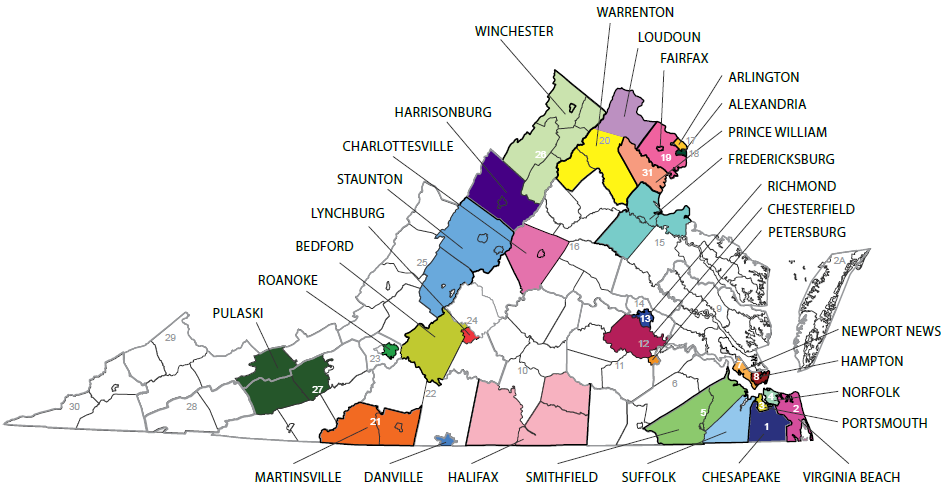
Established in 2004, the Virginia Indigent Defense Commission (VIDC) oversees the state’s public defender system, which operates 29 public defender offices and two satellite offices serving 59 localities. These offices employ approximately 430 attorneys who provide legal representation to individuals unable to afford private counsel, often referred to as an indigent client or defendant. Due to discrimination in employment and other areas, defendants who are Black are more likely to have lower incomes and are therefore more likely to qualify for a public defender or court-appointed attorney. Having a robust public defense system is critical in advancing racial and economic justice throughout the legal system.
Despite the essential services they offer, public defenders are often underpaid and overworked, with many handling increasing workloads. Meanwhile, court-appointed attorneys are paid hourly rates with often-low payment caps per case, resulting in attorneys doing more work for less money than in regular private practice, fewer attorneys being willing to take court-appointed cases, and indigent clients sometimes not having adequate representation.
Public Defenders’ Offices Serve People in Many Virginia Cities and Counties
Public Defenders vs Court-Appointed Attorneys
Before diving into the challenges, it’s important to understand the difference between public defenders and court-appointed attorneys, who both represent people who have limited resources in Virginia.
Public defenders are salaried attorneys employed by the state to represent indigent defendants. They defended 46% of the charges for which the state provided representation in the budget year that ended June 30, 2022 (fiscal year or FY 2022). There are 29 public defender offices operating in various cities and counties across Virginia, providing legal counsel to those who cannot afford private attorneys. As state employees, public defenders receive a salary and full benefits, including health insurance, retirement, and paid leave.
Court-appointed attorneys are private attorneys hired by the court and paid an hourly rate to represent indigent defendants. In Virginia, court-appointed attorneys defended 54% of the charges for which the state provided representation in FY 2022. They are compensated through the state’s criminal fund at $90 an hour, however, their total pay is capped at various amounts depending on the specific charge, with limited exemptions. Court-appointed attorneys play a crucial role in ensuring legal representation, especially in jurisdictions without a public defender’s office.
Underfunding: The Root of the Problem
In FY23, Virginia allocated $127 million to providing people with limited resources access to counsel, split between public defenders ($72.2 million) and court-appointed attorneys ($54.7 million). After JLARC published a major report that detailed problems caused by insufficient funding, legislators boosted support for the Indigent Defense Commission, which funds public defenders, and increased fees paid to court-appointed attorneys.
Despite increased funding, significant challenges remain for Virginia’s public defenders. The state currently allocates $89.4 million to the Indigent Defense Commission. While that might sound like a lot, the reality is that these funds are stretched thin. The vast majority of funding for public defenders (90% in FY2025) goes directly to salaries and benefits for public defenders and support staff. Little is left for other operational needs, such as rent, technology, or administrative support, and the ability to expand services or improve working conditions is limited.
Insufficient funding leaves public defenders struggling to keep up with their cases, often working with inadequate resources. Their workload increased by 47% on average from FY2013 to FY2022. Public defenders report a rise in electronic evidence that requires review, a shift in criminal defense approaches to focus less on punishment and more on meeting people’s social and legal needs in order to help them avoid future involvement with the justice system, and more, as contributing factors. The average time needed for cases increased an average of 70% between 2010 and 2023. Despite the complexity of this work, public defenders remain significantly underfunded and underpaid compared to other parts of the criminal legal system, including prosecutors and law enforcement.
One particularly critical barrier in Virginia’s public defender system is the lack of funding for support staff. Public defenders need paralegals, investigators, and administrative staff to help lift some of the burden from their already stretched caseloads. Without this support, public defenders are left to handle a significant portion of case preparation and administrative work themselves, which further limits the time they can dedicate to each case. Providing support staff is essential to ensuring that public defenders can offer the best defense possible to their clients. In their 2023 report, JLARC stated that “The General Assembly may wish to consider including funding in the Appropriation Act for additional mitigation specialist and paralegal positions to lessen public defender office attorney workload” (Recommendation 5).
Unequal Pay is a Barrier to Justice
A key issue in Virginia’s public defender system is unequal funding at the state and local levels. Some localities across the state provide additional funding to support public defenders, but these supplements are inconsistent and less prevalent than supplements for commonwealth attorneys. In FY23, localities provided salary supplements to 87 out of 120 commonwealth attorney offices. While every public defender’s office served at least one locality that provided salary supplements to commonwealth attorneys, only 14 localities of the 56 served that year provided supplemental funding to public defender’s offices. There has been some improvement recently: 18 local governments (of the 59 served) provide salary supplements for public defenders as of the most recent report from the Indigent Defense Commission.
What’s even more concerning is that commonwealth’s attorneys who prosecute criminal cases receive significantly more in local salary supplements than public defenders. While the amount varies widely by locality, commonwealth’s attorneys received an average of $21,000 in local supplements in FY2023, while public defenders in localities that provided any local supplement received only $15,000 on average. As a result, public defenders were typically paid $12,000 less than commonwealth’s attorneys in the same jurisdiction.
Unequal pay makes it harder to recruit and retain qualified public defenders, especially in jurisdictions with lower local supplements. In localities where commonwealth attorneys made more than 20% above the salary of a public defender, the average vacancy rate for public defenders was 22%. In contrast, localities with small salary gaps had an average vacancy rate of 12%. Although state funding for public defenders has increased since the JLARC report, which was published in November 2023 using FY2023 data, state funding for commonwealth attorneys has also increased during the same time period (from $83.7 million to $110.6 million). Overall vacancy rates for public defenders have fallen recently as pay has increased for both public defenders and commonwealth attorneys, but the unequal investment in commonwealth’s attorneys and prosecution over public defenders creates a greater injustice and imbalance in the system, highlighting the need for equal funding to ensure fairness and equity for all.
Investing in Fairness
Both types of attorneys are vital to a functioning justice system. However, there are critical differences in the resources they receive, with public defenders often being at a disadvantage compared to commonwealth attorneys when it comes to funding, support, and staffing. This shaky foundation affects the recruitment and retention of qualified public defenders, particularly in jurisdictions with lower local supplements, and undermines the fairness of our legal system. Failing to invest in our public defender system only exacerbates racial and economic discrimination already present in the criminal legal system.
To build a truly just system, lawmakers must prioritize increased funding and support for Virginia’s public defender offices in 2026 and ensure they are equipped with the necessary support staff to handle their caseloads effectively. JLARC’s 2023 report provides a roadmap to begin this work, including the recommendation to increase funding for mitigation specialists and paralegal positions and policy options related to improving and standardizing pay for public defenders. Every person deserves access to high-quality counsel, and we cannot achieve a just system without properly investing in the public defenders who provide that essential service. We look forward to working with our partners, the Virginia Indigent Defense Commission, practitioners, and criminal justice reform champions to create a more equitable and fair legal system in Virginia, ensuring that everyone in Virginia — regardless of their race or financial situation — receives the justice they deserve.