September 2, 2026
Fair Share Taxes: A Simple, Effective Solution to Invest in Our Communities
First published Dec. 2023; last updated Sept. 2026
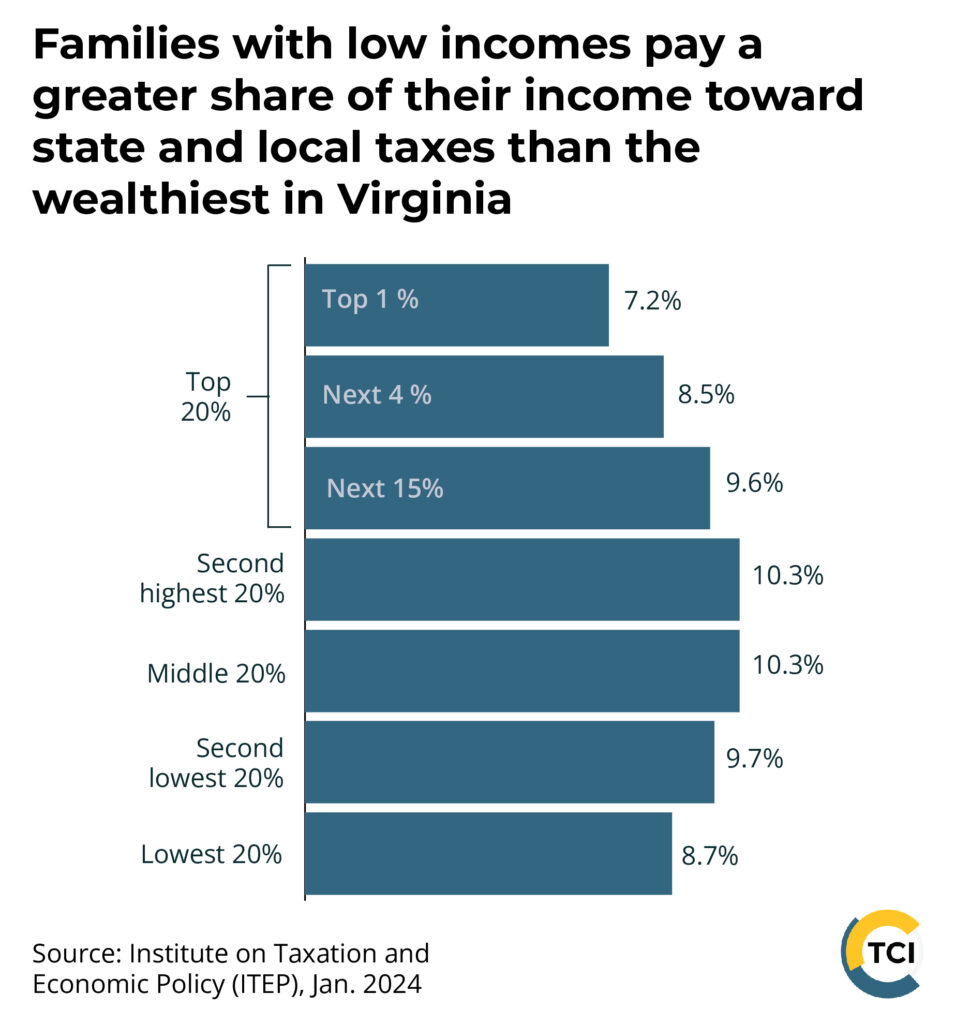
Whether we have $10 to our name or $10 million, we all want to live in a state with good public schools, safe transportation, clean air and drinking water, affordable housing, and high-quality health care. To achieve these shared goals, Virginia needs sustainable revenue to correct years of underfunding and invest in these building blocks of thriving communities for years to come. Unfortunately, a greedy few and special interests have rigged the tax code to get out of paying their fair share. Now, Virginia’s tax code is upside-down — the wealthiest pay the least taxes as a share of income — and it limits our ability to invest in our communities.
In response to budget “surpluses” in recent years, elected officials proposed harmful tax cuts that would further benefit the wealthy and large corporations and drain future resources instead of prioritizing the many unmet needs in our communities. For instance, the state provided 18% less funding to schools than the national average in the most recently available comparison, and billions are needed to fully fund our schools. About 100,000 children in Virginia are without health insurance, requiring substantial state funding to remove barriers and connect children to coverage. And across the state, tens of thousands of families face eviction amid a broader housing affordability crisis that requires a robust investment. To address these and other needs, we must protect and raise adequate resources, not give up revenue that we could invest in our communities.
Lawmakers have the opportunity, and should boldly act, to advance tax fairness so that we can invest in all of us. One simple and effective solution is to ask millionaires and billionaires in Virginia to pay their fair share. Establishing a fair share millionaire’s tax would raise more than $2 billion each budget year that can be used to meet the needs Virginia residents have continually identified in their communities and to fund the programs and services that will benefit all of us.
Virginia’s Outdated Income Tax Structure Holds Us Back
Where we are
Virginia has an upside-down tax code: when considering all forms of state and local taxes — income, sales, and property taxes — families with lower incomes in Virginia pay a greater share of their income on taxes, while those with the highest incomes pay less. In recent years, lawmakers made some progress in addressing the upside-down structure, adding and improving a refundable option to the state Earned Income Tax Credit (EITC) that allows families to receive more of the credit they earned, increasing the standard deduction, and removing the state sales tax for grocery and hygiene items. However, more work needs to be done to create a truly fair tax structure that makes sure the wealthiest among us are paying their fair share and provides the resources needed to invest in communities.
Virginia’s current income tax is an artifact of its incremental, then stagnant development. Virginia has had a version of an income tax on the books since 1843 and was one of the first six U.S. states to adopt the modern state income tax in 1916. In the more than one hundred years since its adoption, the state income tax has become a key revenue source for the general fund, the part of the budget for which lawmakers have the most flexibility and is primarily used for programs like education and health and human services. Individual income taxes made up more than two-thirds of general fund revenue in the budget year that ended June 30, 2026 (fiscal year 2026).
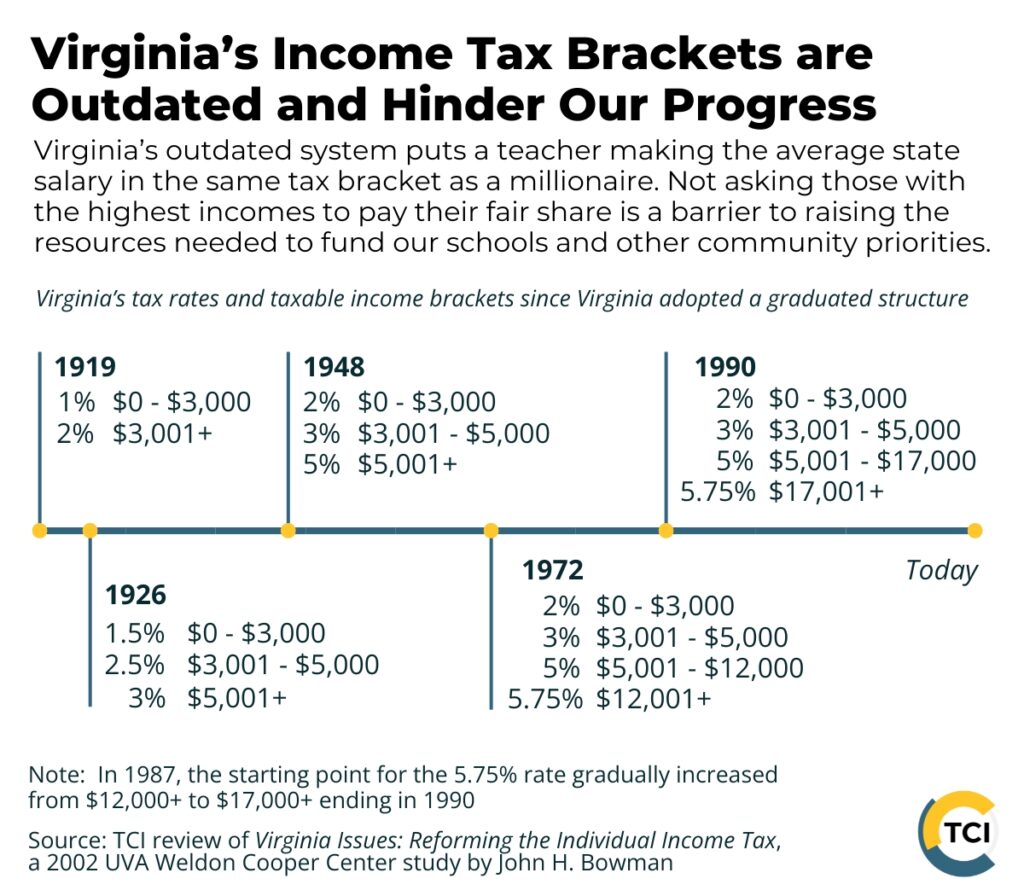
While Virginia’s current income tax brackets have been in place since 1990, there has been surprisingly little change in its century-long development. Virginia adopted a graduated rate structure in 1919, with people paying 1% in taxes on the first $3,000 of taxable income (income after exemptions and deductions) and 2% on taxable income over $3,000. The threshold for the first income tax bracket ($3,000) remains unchanged.
In 1926, lawmakers added a third bracket: people paid 1.5% on the first $3,000 of taxable income, 2.5% on the next $2,000, and 3% on income over $5,000. In 1948, lawmakers increased those rates to 2%, 3%, and 5% for the same income brackets — where they remain to this day. Further reform did not happen for another 24 years. In 1972, lawmakers added a fourth (and currently final) bracket, and people began paying 5.75% on taxable income over $12,000. The starting point for that top bracket gradually increased to $17,000 between 1987 and 1990. Virginia’s income tax structure has remained untouched ever since.
While Virginia’s income tax is progressive in structure — people pay a higher tax rate as their ability to pay increases — the top bracket kicks in at a relatively low threshold. Today, people pay 5.75% on all taxable income over $17,000, and decades of inflation have pushed greater portions of Virginians’ incomes into the top bracket. As a result, a teacher making the average teacher salary in Virginia of $69,254 is in the same top tax bracket as a millionaire. This outdated structure is a barrier to raising the resources needed to fund our schools and other community priorities.
Momentum for change
Lawmakers have recently considered adjusting the state income tax brackets. However, some proposals failed to advance fairness in the tax code, failed to raise essential revenues, or both. During budget negotiations in 2023, negotiators considered (though, ultimately, did not pass) several changes to the personal income tax structure, including lowering the top income tax rate and adjusting the bracket thresholds. Lowering the top rate would have given greater benefits to the wealthiest in the state, while doing very little for middle- and lower-income families. While proposals to alter the income tax varied in size and impact, none would have raised revenues or made sure the wealthiest among us pay their fair share.
Calls to adjust Virginia’s decades-old state income tax structure are nothing new. A 2002 study by John H. Bowman (then an economics professor at Virginia Commonwealth University) for the University of Virginia Weldon Cooper Center for Public Service suggested that lawmakers reimagine the state income structure. Almost two decades later, the state legislature asked its independent research agency (Joint Legislative Audit & Review Commission, JLARC) to research the matter. JLARC ultimately outlined a menu of 10 options to make Virginia’s income tax more fair.
A Fair Share Tax is A Simple, Effective Solution
In its 2022 report on how to make the state tax code more fair, JLARC outlined 10 options, four of which would raise much-needed state revenues. Two options were estimated to raise $1 billion, including adding a new tax bracket that would have a very small share of people pay 10% on taxable income over $1 million. A 2026 fiscal impact statement for legislation proposing a fair share tax estimated that it would generate over $5.1 billion in its first two fiscal years.
How would creating a millionaire’s tax work?
A fair share millionaire’s tax would help clean up our tax code by adding a new and long-overdue bracket to Virginia’s income tax structure for the first time since 1972, making sure people with the highest incomes contribute their fair share. The vast majority of people in Virginia would see no change in the income tax they pay. They would continue to pay 5.75% on taxable income between $17,001 and $1 million. A small group would pay a 10% rate — just 4.25 percentage points more — only on taxable income over $1 million. If someone made $1,000,001 in annual taxable income, for example, they would only pay 10% on that last dollar.
Very few people would pay a Fair Share Tax
Recent estimates from the Institute on Taxation and Economic Policy (ITEP) show that just 0.55% of Virginia tax filers would pay higher taxes under this proposal, meaning that 99.45% would not see a tax increase. Among the small share who would pay more, their Virginia individual income tax would increase by just 2.26% of their income on average.
“JLARC’s research shows that very few Virginians would pay higher taxes under this proposal — an estimated 17,700 — and that 99.6% of filers would not see a tax increase.”
Only “income millionaires” — people who report over $1 million of Virginia taxable income in a single year on their tax return — would pay the higher rate. This is different from having a net worth of more than $1 million. Assets someone owns, such as a home, investments, or retirement savings, do not count as taxable income. What is considered taxable individual income varies between the state and the federal government.
In Virginia, an asset only boosts taxable income when it is sold for a profit, also known as a “realized capital gain.” And only the profit, not the full value, would be considered income when applicable. For example, owning a boat does not increase someone’s income. But if they sell the boat for more than they paid, including improvements, the profit could be considered a taxable capital gain. While sometimes taxed differently at the federal level, Virginia mostly considers capital gains and certain qualified dividend income as taxable individual income.
Some profits are excluded from taxable income under state or federal rules. For instance, long-term capital gains from investment in certain “qualified businesses” get special treatment in Virginia under certain conditions, including advanced computing, agricultural technologies, and nanotechnology, just to name a few. Federal rules that Virginia follows also exclude up to $250,000 in profit from the sale of a qualifying primary residence, or $500,000 for a married couple. If a married couple sold a house under qualifying conditions and made a $500,000 profit, that profit would be canceled out by the capital gains exclusion and would therefore not be subject to the state income tax.
Money held in a typical retirement account does not count as taxable income, but a withdrawal from the account could. For example, lump sum disbursements from typical retirement accounts that may provide boosts to annual income would be subject to the state’s income tax, though age deductions may reduce the amount of taxable income for retirees. Withdrawals from Roth retirement accounts are not counted as taxable income, and do not typically face taxes except in some cases of early withdrawals.
How could different types of income be affected by a Fair Share tax?
Home Sales. When someone sells their primary residence, the first $250,000 of increased home value, or $500,000 for married couples, can be excluded from taxable income. A person would only pay a state fair share tax if their combined taxable profit (above $250,000 or $500,000) and other taxable income totaled more than $1 million. If someone’s income was just from the sale of their home that year, they would have to sell their home for over $1.25 million more than they bought it for to face any higher tax rate.
Retirement Savings. Withdrawals from traditional retirement accounts are taxed as ordinary income at the federal and state level. If a person withdrew more than $1 million in a single year, or if the withdrawal plus other income was more than $1 million in a year, they could face higher taxes on income that surpasses $1 million.
Withdrawals from Roth retirement accounts are not taxable income, except for some early withdrawals of earnings.
Selling Stock. Profits from selling stock that are considered long-term capital gains face lower taxes at the federal level, but are taxed at the individual income rate at the state level. If the profit from a stock sale, alone or combined with other taxable income, pushes someone’s income above $1 million, the fair share tax would apply to income above that threshold.
State tax policy rarely influences where someone lives
We all want to live in a state where we, and our neighbors, can thrive. Yet a greedy few and special interests are doing everything they can to avoid paying their fair share, including spreading fear and misinformation about how millionaires will respond to paying a higher tax. The truth is that while income millionaires are more likely to consider state tax rates while making a move, they are far less likely to move than the general population. Income millionaires tend to be more embedded in place than the rest of the population — they are more likely to be married, have school-aged children, own businesses, and are often at the peak of their careers in jobs that are difficult to relocate.
Even recent changes that would theoretically incentivize people with high incomes to leave higher-income tax states for lower-income tax states have not led to a mass exodus. These include a new federal limit on deductions for state and local taxes (SALT), which increased federal taxes for some high-income households in higher-tax states, and the rise of flexible remote work during the COVID-19 pandemic. While some have trickled out, not enough high-income households are leaving higher-tax states to offset the additional revenue raised. Researchers have found that states could impose much higher marginal rates before revenue losses from people moving away would outweigh the revenue gained. The research consensus is clear: “Millionaires are not searching for economic opportunity — they have found it.”
Taxes are rarely the primary reason a family leaves a state. People leave their states for employment opportunities, to be closer to family, to find more affordable housing, and for better lifestyle fits. Raising revenue to invest in strong public education, safe and affordable housing, accessible health care, and safe transportation makes a state a more desirable place to live. Lawmakers’ tax choices should focus on helping families to thrive, not protecting the wealthiest among us from paying their fair share.
A Fair Share Tax Would Bring More Resources, Greater Equity
A new tax bracket on income over $1 million would create sustainable revenue to fund our shared priorities and would help address inequities that keep communities from thriving. JLARC found that a higher tax rate for millionaires could bring in over $1 billion in state revenues annually, and newer estimates predict double the amount, which lawmakers could use to make significant investments in long-underfunded public services like public education and affordable housing.
Virginia needs new and ongoing revenue for the challenges ahead
Virginia, like many states, is facing economic uncertainty and new costs from federal policy choices. The 2025 Trump tax law cut access to food and health care to help pay for massive tax cuts for the richest people in the country, leaving Virginia to spend more to maintain the state’s commitment to providing essential services.
Despite higher-than-expected revenue in the short term, Virginia’s long-term revenue outlook is more uncertain. Budget forecasters told lawmakers in 2025 that required spending is expected to outpace revenue growth in future budget cycles, leaving very little room to maintain the status quo, let alone make new investments. While legislators were able to add new resources to the 2026-2028 budget, much of this revenue is limited. Some new, ongoing revenues were added from a spring 2026 revenue reforecast. However, the fiscal year 2026 surplus carried forward to fiscal year 2027 is one-time resources. While there are also funds from a new tax for data center electricity consumption, it is both temporary and limited in how much revenue it can generate.
A new powerful and ongoing revenue source could breathe life into the budget, giving lawmakers more flexibility to meet Virginia’s needs now and into the future.
Avoiding harmful cuts in future downturns
Economic uncertainty also makes new and ongoing revenue important, helping to protect and improve public services in future downturns. Cutting public investment in the foundations of our communities in the name of so-called “fiscal responsibility” — an approach known as austerity — can cause lasting harm to our communities. Tax giveaways to the wealthy and profitable corporations also leave the state with fewer resources to invest in our shared priorities.
Virginia’s choices during the Great Recession greatly impacted low-income communities and communities of color and offer an important lesson. For example, rather than raising new revenues, Virginia lawmakers cut school funding and put limits on future spending. Those cuts hit school divisions with the highest poverty rates almost three times harder than divisions with the lowest poverty. Cuts to support staffing were also four times larger in school divisions with the highest shares of students of color than in those with the highest shares of white students. Some of these consequences are still felt today.
Establishing new revenue streams now can help protect critical services in the future, especially as the state is forced to absorb new costs resulting from ongoing and future federal cuts to SNAP and health care.
A step toward racial and economic justice
Even with recent actions to make Virginia’s tax code more fair, high-income households still pay a lower share of their income on taxes than low- and middle-income households. A new top tax bracket would help address this imbalance by asking the wealthiest among us to simply pay their fair share.
Income has also become increasingly concentrated in the hands of the wealthy few in Virginia. In 2022, households in the bottom 90% of incomes had just 51% of all state income, down from 65% in 1990. Meanwhile, the top 1% had 19% of all individual income, up from 11% in 1990. While not as concentrated as the top 1% of incomes nationally, this comes at a time when global income inequality persists, and wealth is increasingly concentrated in the hands of very few people.
A new tax bracket would also be a meaningful step toward racial equity in Virginia. Historic and recent policy choices rooted in anti-Blackness — including discrimination in housing access, lending practices, and education spending — have created significant barriers to Black Americans building wealth and income at levels similar to their white peers. This inequality persists today. In Virginia, median household income for Black households is just 73% of the state median, compared to 107% for white households.
Virginia’s upside-down tax system exacerbates this inequality, harming Black and Latino communities while allowing wealthier, primarily white, individuals to avoid paying their fair share. Adding a new top tax rate would make sure that the wealthy who have profited from this system pay their fair share so that, together, we can achieve our shared goals. The revenue would be invested in critical services like education and affordable housing, where underinvestment and systematic discrimination have overwhelmingly harmed Black families in the commonwealth.
What Fair Share Taxes Make Possible in Other States
Asking people to pay a higher tax on higher incomes is not unusual. It has been an increasingly popular strategy for states to create sustainable revenue streams while generating greater equity through their tax code. Here are some success stories from a few states that have added higher rates for millionaires.
MA: In 2022, Massachusetts voters approved a 4% surtax on taxable incomes over $1 million to fund public education and transportation. Between July 1, 2025, and June 30, 2026, the Fair Share Amendment generated $3.4 billion, consistently surpassing initial projections of $2 billion a year. This revenue has helped keep K-12 meals free for all public school students and allowed free-fare transportation programs to expand. The number of wealthy people worth over $1 million has also continued to grow since Fair Share’s passage.
NJ: New Jersey has applied higher tax rates to very high incomes for more than two decades. In 2004, the state established an 8.97% bracket for income over $500,000. Lawmakers added a 10.75% rate on taxable incomes over $5 million in 2018 and extended that rate to taxable income above $1 million in 2020. At the time, the 2020 change was estimated to raise $400 million a year.
NY: New York has had higher tax rates on high incomes since 2009, and now has multiple tax rates on income over $1 million, reaching 10.9% on taxable income over $25 million. This has raised critical revenues for public services. While some millionaires left New York in recent years, the overall number has continued to grow. New York reported about 54,200 millionaires in 2020 and about 67,400 in 2024, although the number peaked at nearly 70,400 in 2022. Meanwhile, fewer than 1,700 left in 2024.
CA: California’s top income tax rate is 12.3%, with an additional 1% surcharge on taxable personal income over $1 million. The surcharge was established in 2004 to make transformational investment in the state’s behavioral and mental health system. In 2024, voters approved changes to how revenue from the tax is used, including greater support for housing, substance use treatment, and the behavioral health workforce. In their 2026 budget year, the 1% surcharge was expected to generate over $3.6 billion for behavioral health programs in California.
D.C.: The District’s tax code is one of the most fair in the country when ranked among all U.S. states. D.C. increased its tax rate on taxable income over $1 million from 8.95%, which began in 2016, to 10.75% beginning in 2022. Along with other rate increases on high incomes, the changes were initially estimated to raise a combined $100 million in new revenue for the first budget year to support investments including affordable housing and raising pay for childcare workers.
MD: Facing a $3.3 billion revenue shortfall in 2025, Maryland lawmakers raised new revenue to avoid deeper cuts to public services. The changes included a new 6.5% rate for income over $1 million for single filers and $1.2 million for joint filers. Together, the new income tax changes were estimated to raise $580 million a year, with 82% coming from the top 1% of households. (Because Maryland has a local option piggyback income tax, in the Maryland suburbs of D.C., the top combined state and local income tax rate is now 9.7% for ordinary income and 11.7% for capital gains.)
WA: In 2026, Washington enacted a 9.9% rate on taxable income over $1 million, a major change for a state that has historically had one of the nation’s most upside-down state and local tax systems due to its lack of a statewide income tax. Starting in January 2028, the new tax is expected to raise over $3 billion annually to help health care, education, and other core services. Additionally, revenue would support expanding tax credits for low- and moderate-income families, sales tax exemptions on grooming and hygiene products, and tax reductions for small businesses.
ME: In April 2026, Maine raised its top tax rate from 7.15% to 9.15% on taxable income over $1 million for single filers and $1.5 million for joint filers. The change will affect fewer than 0.5% of tax filers – about 2,600 people — and help address a tax system in which the top 5% have historically paid a lower share of income in taxes than working families. Together with other tax and budget changes, it will help raise nearly $100 million in revenue to make key investments, including free community college for Maine residents and higher minimum salaries for public school teachers.
HI: In May 2026, Hawaii’s legislature approved a new 13% top rate on taxable income over $1 million for joint filers, up from 11%. The change is expected to affect about 0.4% of all tax filers and generate an additional $53 million. By asking more of the highest-income households, Hawaii was able to make life more affordable for working families by generating crucial funding for community resources and maintaining income tax cuts for about 90% of families.
RI: Rhode Island created its first millionaire’s tax in 2026, a 3% surcharge on income over $1 million a year, putting the state’s top income tax rate at 8.99% in 2029. The surcharge will be phased in over three years and is expected to raise over $150 million a year once fully implemented. The same budget also created the state’s first permanent, fully refundable child tax credit to help support families.
A Fairer Tax Code Can Help All of Us Thrive
A fair share millionaire’s tax could raise more than $1 billion a year in ongoing revenue to fund vital public services we all rely on while making our tax code more fair. Raising revenue gets us closer to a Virginia where all can thrive: where every student in every zip code has access to a high-quality public education, where everyone has access to safe and affordable housing, and where the wealthy pitch in their fair share to the communities where they have found economic opportunity. Lawmakers can help make that future possible by asking the wealthiest among us to pay their fair share and investing those resources in our shared priorities.
Endnotes
- Bowman, J. “Virginia Issues: Reforming the Individual Income Tax,” for UVA Weldon Cooper Center, 2002
- This exclusion is said explicitly to apply in VA in this tax department ruling https://www.tax.virginia.gov/laws-rules-decisions/rulings-tax-commissioner/11-48 “In the case of a personal residence, however, IRC § 121 provides an exclusion for a gain from the sale or exchange of a principal residence. Because Virginia begins it computation of Virginia taxable income with FAGI pursuant to Va. Code § 58.1-322, Virginia’s conformity to federal law, as is set forth in Va. Code § 58.1-301 permits an exclusion on the gain from the sale of a principal residence to the extent allowed for federal income tax purposes. As such, if the Taxpayers gain from the sale of their Virginia home does not exceed the amount of the exclusion, no gain would recognized for Virginia income tax purpose.”
- Much of this section derives from the research of Cristobal Young, a leading researcher on millionaire tax migration. Quote is found in Cristobal Young, et al., “Millionaire Migration and Taxation of the Elite: Evidence from Administrative Data,” 2016