December 10, 2025
Honest History: How Fines and Fees Came to Harm Black Communities in Virginia
Proliferation of Fines and Fees and Their Impact on Black Virginians
Court Assessments Rose Along With “Broken Windows” Policing
In addition to the emotional and financial devastation of arrest and imprisonment, courts in the United States increasingly assessed fines for petty crimes during this “tough on crime” era. Levying the fines was intended to both punish individuals for the offense and deter future criminal action. Along with these fines come court “costs” or “fees,” which aim to generate revenue and may be used to fund services such as court administrative costs. The rise in fines and fees as an enforcement tool against low-level offenses may be attributed to their relative ease of implementation and perceived ability to generate revenue for the courts. While some of these low-level offenses may have previously gone unenforced, fines and fees encouraged law enforcement to focus on these violations, resulting in the accumulation of court debt for the Black Americans who were overwhelmingly targeted by “broken window” policies in the first place. By 1987, 86% of all lower court cases nationwide involved imposing a fine.
Sometimes, fees charged for court services exceeded actual court costs and were used to fund other public services. This transferred costs from the general public to those who found themselves before a district or circuit court, who are often the people with the least ability to pay. In Virginia, during this period of increasing “tough on crime” laws and policing, local governments received two-thirds of all “excess” fees collected by circuit court clerks, while the state retained one-third. This means that, to the extent fees exceed authorized staffing levels, local governments could use them for other purposes. Between fiscal year 2001 and fiscal year 2005, circuit court expenditures decreased slightly, while excess fees more than tripled from $17.7 million to $56.3 million.
Total assessments by Virginia courts of fines and costs, excluding non-judicial transactions such as tax and fee payments on land transfers, rose 38% between fiscal year 1998 and fiscal year 2011, even after adjusting for inflation. Since 2011, assessments have dipped, falling below 1998 levels in fiscal year 2021 after adjusting for inflation. Unfortunately, assessments ticked up slightly in fiscal year 2024 even after adjusting for inflation, a potential sign that fines and fees are rising again as the criminal legal system “returns to normal” post-pandemic.
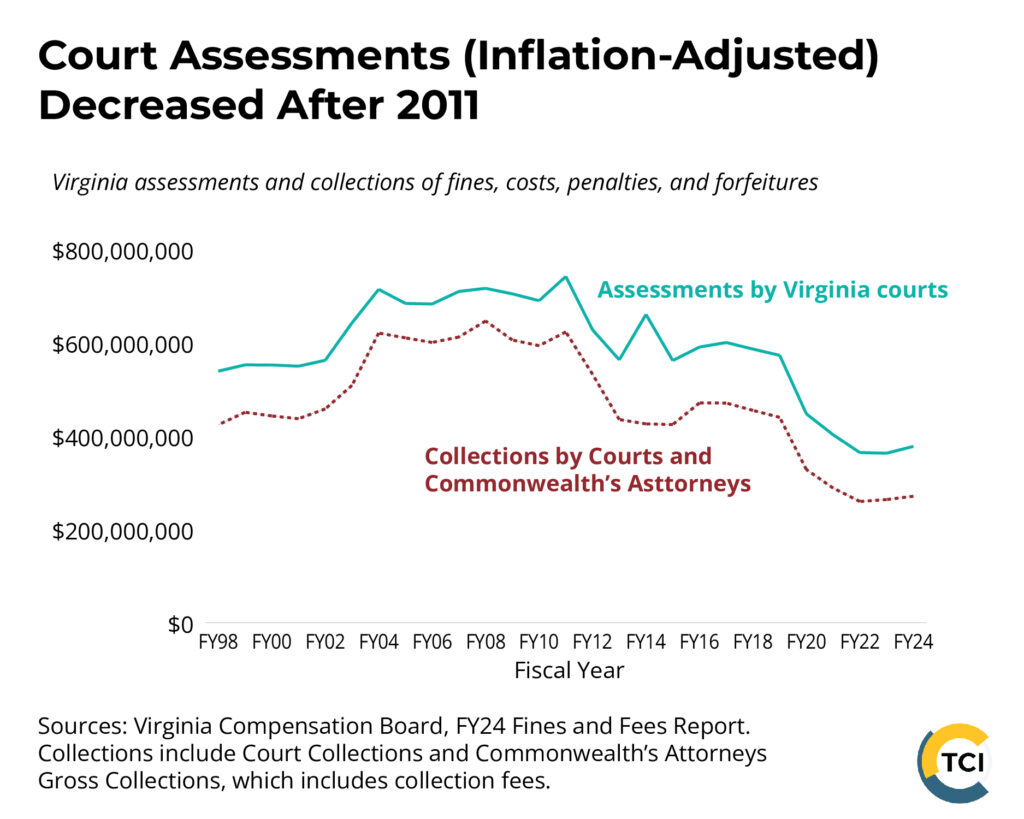
Examples of fee increases that may have contributed to the heavier burden of court assessments include the “fixed fee” for misdemeanor and traffic cases heard in District Court, which funds various court-related functions. These were increased by the General Assembly in 2002 from $28 to $42 for traffic cases and $28 to $57 for most misdemeanor cases. Fees were set higher for drug-related misdemeanors, increasing from $103 to $132 at that time. Today, these fees are $51 for traffic cases, $61 for most misdemeanors, and $136 for drug-related misdemeanors. Fees are higher for circuit court cases, including for misdemeanors heard in circuit court.
With the system targeting Black Americans who have been systematically disenfranchised and economically disadvantaged, the next logical question may be: “What happens if you can’t pay?” If individuals do not have access to funds to pay the full amount of their debt upfront, courts could penalize late payments and sometimes would charge interest. With interest accruing on unpaid court debt over time, the costs associated with petty crimes, which were once meant to act as deterrents for those crimes, turned into a lifetime of debt for those most unable to pay. Many states, including Virginia, may even jail people for failure to pay fines and fees. Additionally, because these laws and policies most heavily targeted Black communities, and job discrimination and other structural barriers led to Black people being paid lower wages than their white peers, Black people in particular were being punished and trapped into a cycle of debt, poverty, and criminal legal involvement.
Fines and Fees Become a Barrier to Participating in Democracy
The evolution of disenfranchising Black people can be seen through the use of fines and fees as a barrier to regaining their right to vote, specifically by requiring the complete payment of these costs to be able to vote. Despite protections established during the Civil Rights Era to prevent systemic Black disenfranchisement, this “wealth-based disenfranchisement” became a new legal way to prevent Black participation in elections. This extended and compounded the harm from the ongoing presence of language in Virginia’s constitution that takes the right to vote away from people who have certain criminal convictions. In many states, including Virginia until 2015-2016 and perhaps again in recent years, voting rights are not restored until someone has not only been released from incarceration and/or completed probation and parole, but also paid all fines and fees resulting from their criminal case.
This roundabout disenfranchisement of poor people and people of color has created a modern-day “poll tax” that is imposed only on those caught in the snare of the criminal legal system. Today, nearly 6 million people are denied the right to vote due to a past conviction, and, for many, this inability to vote is contingent upon their ability to pay court fines, fees, costs, and restitution.
The Virginia Constitution disenfranchises all citizens with felony convictions, unless the governor restores their voting rights. In 2016, Governor McAuliffe attempted a blanket restoration of rights for all Virginians with felony convictions. The Virginia Supreme Court struck down this executive order and declared that the governor was required to sign each restoration of rights on an individual basis.
While this executive action has restored the participation of hundreds of thousands of Virginians in our democracy, inability to pay legal debt may extend an individual’s probation and therefore potentially prolong disenfranchisement, as well as influence the governor’s decision on whether the person’s rights should be restored. As of September 2025, Governor Youngkin’s form to request re-enfranchisement asks about outstanding fines, fees, and restitution, whether the person is currently paying those assessments (with proof of payment required), and whether the person is still on probation. In Virginia in 2024, 4% of voting-age U.S. residents were disenfranchised due to a felony conviction. While Black people make up less than 20% of Virginia’s voting-age population, they account for nearly half of Virginians who are disenfranchised due to felony convictions.
Funding Critical Investments through an Upside-Down System
Alongside the direct use of fines and fees as a tool for disenfranchisement and money-making for local courts, Virginia has a history of relying on regressive revenue sources, where people with less pay a greater share of their income than the wealthiest households. The long-standing use of court fines and fees to fund public services can be seen as part of this pattern of avoiding taxes on wealthy people and as an outcome of limiting the types of taxes that local governments and constitutional officers can levy, thereby pushing reliance on regressive revenue sources, including fines and fees.
For example, during the post-Civil War Era, elected officials who prioritized paying off (rather than negotiating) Virginia’s pre-war debt nonetheless kept taxes low on banks, insurance companies, and railroads, instead turning toward regressive revenue sources such as levies on liquor and dogs. When that revenue wasn’t sufficient to meet their goals, these same policymakers sharply cut state funding for the recently established public school system, resulting in half the schools closing, the imposition of fees, and the denial of education to more than 100,000 children.
The “Literary Fund,” which was established in the early 1800s and was Virginia’s most significant early attempt to broaden educational opportunities beyond the wealthiest people in the state, relied on escheats (property transferred to the state because it has no “known” owner, including upon the death of an owner with no heirs), confiscations, fines, penalties, forfeitures, and unclaimed property. The “Literary Fund” structure, with its reliance on fines, forfeitures, and unclaimed property, continues today. But rather than being used to provide direct assistance to educate low-income students as was originally intended, lawmakers have frequently used the fund to reduce other state support for public schools. Furthermore, in 1990, Virginia voters approved a constitutional amendment directing some forfeitures to go to law enforcement rather than education. By relying on Virginia’s upside-down systems of fines, fees, and taxes that particularly harm Black people, policymakers have avoided making wealthier, typically white individuals and corporations, pay their fair share of taxes to invest in the building blocks of our communities, including education.
When fines and fees become an essential part of funding the system instead of a means to promote safe communities, there is bound to be misuse. An egregious instance of misuse can be seen in the fines and fees system of Ferguson, Missouri. The United States Commission on Civil Rights found that not only did Ferguson law enforcement prioritize raising money through fines and fees, but nearly every facet of the system purposefully targeted Black and low-income communities. While Ferguson has been at the forefront of national attention due to civil unrest in 2014 after the police killing of unarmed teenager Michael Brown, it is not alone in its biased assessment of fines and fees against Black people.
The state of Virginia limits the taxing authority of local governments, setting caps on business and sales taxes and banning local income taxes. This leaves local governments with few flexible revenue sources beyond property taxes, and some turn to traffic stops, fines, and fees to fund local law enforcement.
Virginia jurisdictions that rely on ticketing as a revenue raiser have been known to target Black drivers with traffic stops at a rate greater than the group’s share of the population. Legislators did seek to limit revenue-motivated traffic stops by passing a provision to transfer to the state the amount of fines a locality collects above a certain threshold, but that law was unfortunately repealed a few years later under the guise of local government rights and revenue needs.
More broadly,law enforcement in Virginia stops Black drivers at much higher rates than white drivers, and stops Latino drivers at somewhat higher rates than white drivers (data for Latino drivers may be undercounted due to law enforcement coding some Latino people as white). In 2023, Virginia law enforcement subjected Black Virginia residents to almost 30% of all stops of Virginia residents, despite Black people being only 19% of the state’s driving-age population. Once stopped, law enforcement conducts vehicle searches for 2.5% of Black and Latino drivers, compared to just 1.6% of white drivers. Both traffic stops and searches can lead to more tickets and low-level criminal charges, pulling people into the criminal-legal system and subjecting them to a range of fines and fees. Although the report on 2024 data was due July 1, 2025, it does not appear to be available yet as of October 2025.
This is not just a problem in one or two “speed trap” localities. Black people are more likely to be subject to search or arrest after a stop by 75% of the Virginia law enforcement agencies for which sufficient data is available to conduct analysis, according to a deeper analysis of the Virginia Community Policing Act data from July 1, 2020, to September 30, 2023, by researchers at JULIAN. In 94 of the 341 agencies for which sufficient data was available for analysis, there was a statistically significant difference in the rate of searches and arrests of Black people during stops compared to non-Hispanic white people, and in 39 of the 341 agencies, there were significant disparities in 3 or more measures. When the researchers at JULIAN broke down the analysis by time period, the agency that most frequently tested as having disparate outcomes across years and type of test was the Virginia State Police, which failed 33 of 35 tests. Although the researchers found some positive trends in terms of decreasing disparities over the 3+ years for which data was available, and there were many law enforcement agencies that did not have disparities on many of the year-test pairs, the persistence of unfair approaches to traffic stops and then searches and arrests of Black people after stops creates legal and financial challenges for Black people and communities.
Present-Day Implications of Fines and Fees for Virginia
With Black people being subjected to more frequent traffic stops, our existing knowledge that Black neighborhoods are more heavily policed than white neighborhoods, and the ongoing use by the court system of fee revenue for basic operations, it’s not surprising that Black people and communities with many Black residents also face higher levels of assessments of fines and fees.
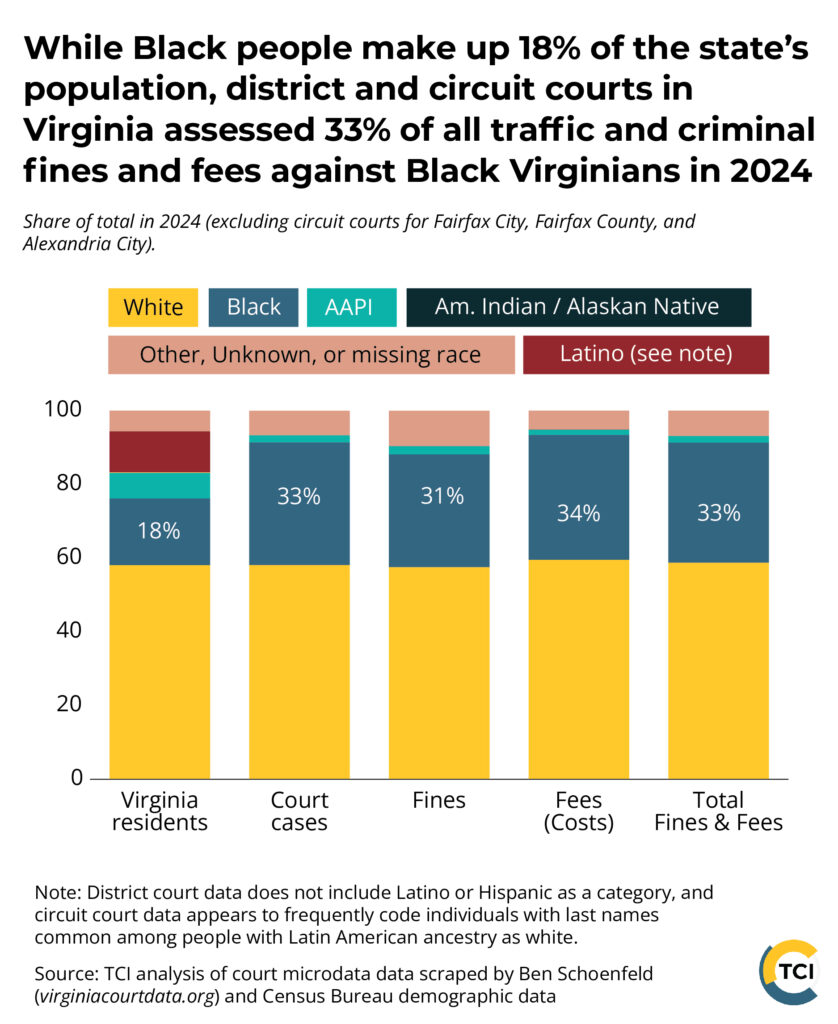
In 2024, District and Circuit Courts in Virginia assessed at least $84.4 million in fines and fees related to traffic and criminal cases against Black Virginians, which was 33% of all traffic and criminal fines and fees, while Black Virginians make up just 18% of the population (this grows slightly to 21% when counting multiracial people who identify as Black and another race).
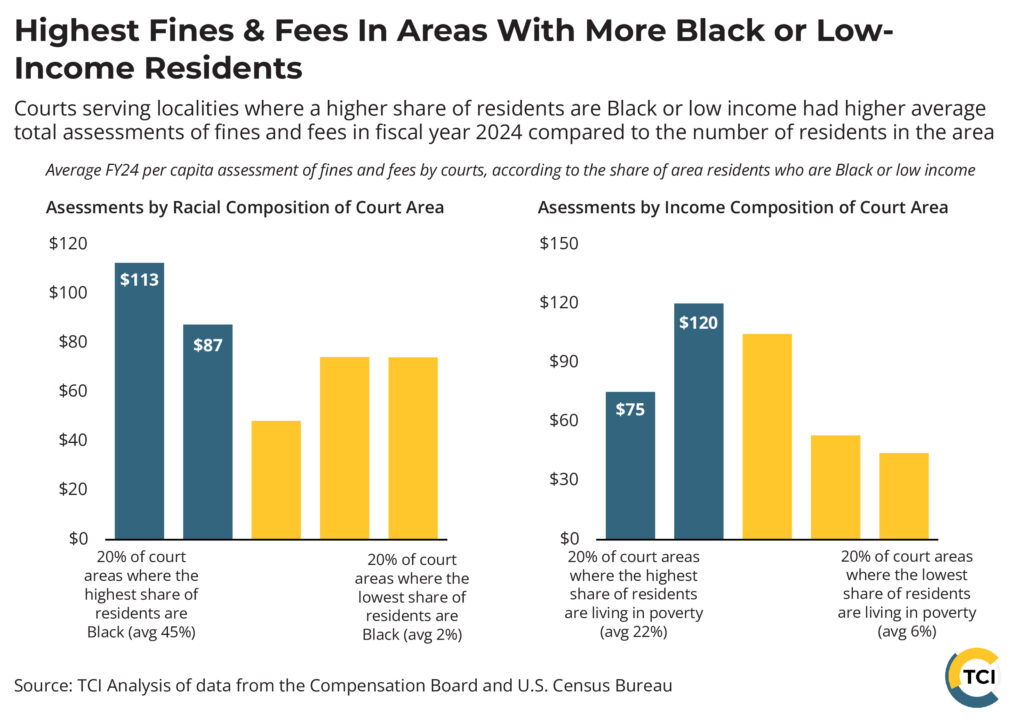
We can also see the impact on the community level. People who live in communities with many Black residents and those who live in communities with many low-income residents face especially frequent fines and fees. When it’s not just you, but also your family members and friends who are hit with court bills you can’t afford, it keeps many Black families and communities at a perpetual economic disadvantage.
The overuse of fines and fees in Black and low-income communities is exacerbated by courts adding on additional costs when debts go unpaid. If there is no upfront payment in full, lengthy statute of limitations laws, interest charges, and other additional costs can hike charges even higher. In Virginia, the statute of limitations for court debt collection is 30 years for the general district court and 60 years for the circuit court. These lengthy statutes of limitations keep people in a cycle of debt for decades and often the rest of their lives, trapping them and their families in poverty.
Additional costs penalize individuals who cannot pay the debt in full up front or enter and maintain a payment plan, effectively implementing a “poor tax” for Virginians with low incomes. Court debt begins to accrue interest after a period of non-payment. Additionally, in some jurisdictions, individuals must return to the court of jurisdiction to set up this payment structure, creating another barrier for individuals without access to transportation. Further, while a law was passed in 2021 to prevent courts from requiring a down payment to enter into a payment plan, in practice courts are still encouraging, and effectively coercing, individuals going through this process to put a lump sum down. Moreover, if an individual with court debt is not in a payment plan and is employed, up to 25% of each paycheck may be garnished and used toward their outstanding debt, which may harm a family already living paycheck-to-paycheck. Alternatives to paying court debt, such as community service, are also inconsistent and unattainable for many who need alternatives to payment. All of these stipulations and barriers to payment surrounding Virginia court fines and fees result in locking people into cycles of debt with a clear racial bias against Black Virginians.