November 12, 2026
Lessons for Today: How Race and Power Shaped Virginia’s Tax Choices
Communities in Virginia deserve a tax system that works for all of us — one that raises the resources we need for good public schools, health care, and other building blocks of thriving communities, while asking less of those struggling to get by and more of the wealthiest among us.
Taxes are how we come together to fund what our communities need. But our tax code is also a set of policy choices: who pays, how much, and how those resources are invested. Today, Virginia’s tax code is upside down, where the ultra-wealthy pay less in taxes as a share of their income than those with the least. This impacts Black families in particular, who are more likely to have lower incomes because historic and ongoing policy choices created barriers to good-paying jobs, educational opportunity, and opportunities to build wealth.
These outcomes are no mistake. For centuries, wealthy, white families held much of the power to shape Virginia’s tax code, and often used that influence to maintain their power and reinforce racial and economic hierarchies. Discriminatory poll taxes placed additional costs on free Black people and were later used to restrict access to the ballot. Black-owned property was assessed unfairly. And Black communities contributed to shared resources while being denied access to many of the opportunities those resources made possible — all while being excluded from having a voice in these decisions.
Virginia still has choices to make about our tax code. While the explicitly discriminatory tax laws of the past are gone, their harmful impacts remain, and today’s choices can deepen that harm. Understanding this history can help us make different choices today, including building a more fair tax code and investing more in communities that have too often been denied opportunity.
1619-1700: Colonial Government, Taxation, and Power
Taxation in Virginia predates the United States itself. In 1619, representatives from 11 English settlements met as Virginia’s first General Assembly, the earliest representative government in the colonies that would become the United States of America. That same year, the first enslaved Africans were stolen from their homes, sold, and forced to labor in the North American colony of Virginia. Representative government was taking shape within a colony that was also building a system that denied Black people freedom, equality, and democratic participation. That government hardly represented the colony as a whole, and political power was held by white, land-owning men.
In its first session, the General Assembly passed its first tax law: a poll tax of one pound of tobacco to pay assembly officers for their work. At the time, a “poll tax” did not mean a tax someone had to pay in order to vote. “Poll” was an old word for “head,” and a poll tax was simply a set amount charged per person or head of household. Because it was simple to assess and collect, the poll tax became an important revenue source in colonial Virginia. Centuries later, Virginia would tie payment of a poll tax to voting, giving the term its more familiar meaning.
In the years that followed, the House of Burgesses continued to assert its authority over taxes in the Virginia colony. Taxes in these early days typically had a specific purpose, including funding wars against Indigenous peoples to expand into and colonize their land. While the royal governor would attempt to regain tax rights, the House of Burgesses would ultimately hold colonial tax authority by the end of the 17th century.
The poll tax, payable in tobacco, also expanded. In 1623, it applied to all adult planter men, and by 1630, it applied to all persons, regardless of age or sex. Enslavers were responsible for paying the tax on the people they enslaved. Despite some attempts to collect more revenue based on land and property, the poll tax was Virginia’s primary form of direct taxation in the colony’s first 100 years. Virginia also collected customs duties (a power now reserved for the U.S. federal government) on goods moving in and out of the colony, reflecting its trade economy. These duties applied to tobacco and liquor, as well as to the importation of enslaved people.
As land and wealth became more concentrated in the hands of fewer white landowners, the poll tax became increasingly unpopular. Wealthy landowners faced larger tax bills as the number of people they enslaved grew, while white people with fewer resources objected to the poll tax since it did not account for their ability to pay.
1700s-1860: Poll Taxes, Income Taxes, and Political Power
Poll taxes
During the 1700s, the poll tax was a declining revenue source for the Virginia colony, but policymakers continued to change who had to pay it in ways that reflected the racial and gender hierarchies. White women were exempt, based on the assumption that they did not work, while free Black women and white women in interracial marriages were required to pay. Virginia ended the state poll tax in 1787.
During the 1800s, the Virginia government occasionally instituted new poll taxes, aimed at making Virginia a difficult place to live for free Black residents. In 1813, the General Assembly imposed a poll tax on free Black people who were not bound as apprentices, penalizing freedom of labor. The law was repealed in 1816.
In 1850, lawmakers created another poll tax that applied only to free Black people, aimed at financing the colonization of Liberia. During the early 1800s, some prominent leaders like James Madison and James Monroe advocated for colonization efforts to “return” Black people to the African continent. Virginia’s government, dominated by the white planter class, was hostile to the presence of a free Black population. Lawmakers weaponized tax policy, using it as a tool to make life more difficult by creating different rules for Black and white people in Virginia.
In 1851, the new state constitution expanded voting rights to most white men, while Black people continued to face growing restrictions on their freedom and political participation. It also allowed people voting in future elections to consider population and tax contributions when deciding upon updated legislative maps. Despite paying a greater share of their wages in state poll taxes through the 1850s, taxes paid by free Black Virginians were excluded from these calculations. Enslaved people did not count as full people when calculating population. The same constitution barred formerly enslaved people from remaining in Virginia more than a year after gaining freedom and gave the General Assembly explicit power to force free Black people out of the state.
In 1860, faced with financing their rebellion against the United States government during the American Civil War, the General Assembly implemented a new universal poll tax, on top of the discriminatory poll taxes. The discriminatory poll tax was repealed shortly after.
Early income tax
During Virginia’s early years as a state, its tax code continued to reflect the race-based society lawmakers had built and changes in power and in its economy. As wage work grew more common, the wealthy white planter class that still had much of the state’s political power created the state’s first narrow income tax in 1843. The law exempted ministers, laborers, craftsmen, and merchants, so it applied to very few people. Still, it signaled a shift away from relying as heavily on property taxes and taxes on goods, which placed more responsibility on the politically powerful planter class at the time.
Virginia’s income tax began to take a more modern form after the 1851 constitution expanded voting rights to most white men and established the state’s authority to collect income taxes. As more white men gained a say in government, including those with fewer resources, lawmakers restructured the income tax to ask less of lower-paid workers. In 1853, lawmakers adopted a more progressive income tax structure, exempting the first $100 of income and applying a 1% rate to income over $1,000. Yet the income tax brought in little revenue through the 19th century.
The state had difficulty enforcing and administering the new tax, and Virginia’s population and economy limited how much revenue it could raise. The 1851 constitution prohibited the state from collecting taxes on income derived from property, which applied to land as well as enslaved people. As Virginia developed the income tax, Black Virginians were left out of the conversations, with no political representation.
This was part of the paradox of taxation. Taxes were a means to prove the right of self-government and representation. Yet Black communities contributed to a government that largely denied them both. Free Black people faced discriminatory poll taxes, while enslaved people were treated as property and sources of stolen, unpaid labor without political or legal power. Even as voting rights expanded for white men and taxes became more fair for some, Virginia continued to tighten restrictions on Black freedom and political participation.
1865-1883: Reconstruction, Debt, and the Readjuster Movement
Post-Civil War and Reconstruction
In 1869, voters ratified a new constitution that once again altered Virginia’s tax system. This constitution was the first government document to include Black men in its drafting, and it gave Black men the right to vote. It also set up a universal poll tax to fund a new public education system. Public education was seen as a foundation for civic life, educating all voters in Virginia. Yet public schools remained segregated.
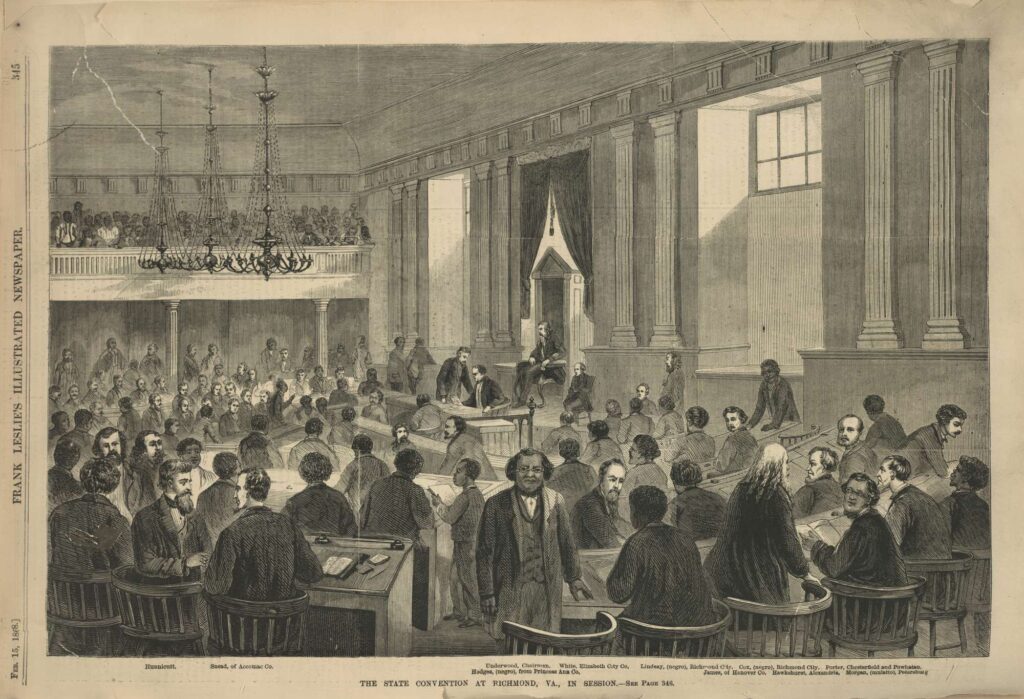
At the time, this poll tax was not tied to the ability or right to vote. That changed after Reconstruction’s abrupt end when old guard Confederate legislators, who became conservative Democrats, gained control of the General Assembly. In 1876, they amended the constitution to require payment of the poll tax in order to vote, taking away voting rights from many Black men with low incomes. Many white men with low incomes were impacted as well.
The poll tax went toward a public education system meant to help prepare people for civic participation. Now, paying that same tax determined whether many people could vote at all.
The Virginia debt crisis and Readjusters
While the new constitution created a public education system, Virginia severely lacked the resources to fund it. The state also faced a growing debt crisis from before the Civil War, much of it for infrastructure that was damaged during the conflict. Little payment had been made toward the debt during the war.
Old guard Virginia legislators who regained control of the state government chose to prioritize paying the state’s debt in full, rather than funding its constitutional obligation to provide public education. Under the Funding Act of 1871, Virginia refinanced much of the debt that state leaders believed Virginia was responsible for repaying. Legislators issued new promises (bonds) to repay people who had loaned the state money, including interest. The terms were expensive. Interest payments alone threatened to take up more than half the state’s revenue. One type of bond also came with coupons to collect interest owed, and lawmakers allowed bondholders to pay taxes with those coupons instead of cash. Poor fiscal estimates and the Panic of 1873, which impacted the United States economy at large, made the situation worse.
Together, these choices and events resulted in a spiraling fiscal crisis for Virginia. By 1873, almost half of the state’s taxes were being paid with coupons. The state had less cash to pay down its debt and to invest in services, particularly its new public school system. Even when the legislature tried to stop accepting coupons for taxes multiple times, the governor vetoed the effort. When lawmakers successfully passed the measure, overriding the second veto, the state Supreme Court ruled that they still had to be accepted.
Still committed to paying the state’s debt in full, the conservative Democrat “Funders” turned to new ways to raise revenues. They relied on regressive taxes, which ask more of people with less, such as increased property taxes, new business taxes, and levies on liquor and dogs. At the same time, they kept taxes low for banks, insurance companies, and railroads. State leaders also looked for ways to reduce spending, or “economize” the government, proposing to shrink local offices and the legislature.
The Funders also tied payment of the poll tax to voting and removed voting rights from people convicted of certain petty crimes. These changes took voting rights away from many Black and white men with low incomes. Once again, the tax system was weaponized to limit civic participation and shift more of the cost of a fiscal crisis created by white elites onto people with fewer resources.
Public schools also paid the price. The Funders slashed public school funding, half the state’s schools closed, and those that stayed open began charging tuition. One Funder state senator went so far as to argue that it would be “better to burn the schools” than fail to repay any of the debt.
Many people were angry that the Funders would not restructure the state debt and fund the new public school system, an initiative popular with both white and Black families with fewer resources. In 1879, a coalition of Black and white Republicans, along with Democrats who supported restructuring the debt, formed a new political movement called the Readjusters. The movement ran candidates for elections, running successfully on restructuring the state debt, funding the new universal public education system, and getting rid of the poll tax. In 1881, Readjusters swept the elections, winning the governor’s seat and a majority in the state legislature.
In 1881, the multiracial Readjuster coalition won the governor’s office and control of the General Assembly. The coalition restructured Virginia’s debt, increased public school funding, and ended the poll tax.
The rise of the Readjusters shows how the fight for tax justice connects to other fights: funding public systems that serve all communities, protecting the right to vote and have a say in those systems, and most greatly, advancing racial justice by changing systems that have treated Black people unfairly and repairing the harm those systems have caused.
While the Readjusters were able to secure many of their objectives — reforming the state debt, increasing funding for public education, and getting rid of the poll tax in 1882 — conservative Democrats played on insecurity and fear among white voters to divide the coalition. They capitalized on backlash following events like the Danville Massacre, where white men killed several Black men amid resentment over Black people gaining political and economic power. They campaigned to win back white voters, and by 1883, the short-lived Readjuster movement lost its majority and was eventually pushed out of state offices. This set the stage for the Jim Crow era and new policies designed to take political power away from Black people.
1902-mid 1900s: Jim Crow and the Modern Tax System
Following the Readjuster movement, conservative Democrats employing tactics of coercion, propaganda, and ballot-stuffing regained control of state government. In the late 1800s, they passed policies to reinforce racial hierarchies and white supremacy.
The 1902 Constitution and voting rights
In 1901, lawmakers met to debate and construct a new state constitution. This convention, and the resulting document, was purposeful in its mission to take political power away from Black men and solidify a rigid racialized social order, now known as Jim Crow. The new constitution mandated a poll tax to vote, alongside other restrictive laws. Not only did this tax need to be paid 6 months ahead of the election, but it also required that the tax be paid for the last three years. In addition, during the first couple of years of the new constitution, registering to vote required “tests” to prove understanding of the state’s constitution. However, people paying property taxes, army and navy veterans of the United States and the Confederacy, and sons of veterans were exempt from the requirement. Local officials decided whether an answer was good enough, leading to rampant discrimination against Black voters.
The political elite debating these measures made their intent clear: the new rules were explicitly crafted to keep Black Virginians out of political life. The restrictions also kept many white men with low incomes from voting. In the years that followed, the burdensome requirements reduced voter participation in Virginia. For Black Virginians, who already faced a segregated labor market, limited educational opportunity, and barriers to building wealth, the poll tax would price many out of their vote while the constitutional test created another obstacle. By 1904, more than 120,000 fewer Black Virginians were registered to vote than in 1900.
Black Virginians resisted the new constitution. John Mitchell Jr. at the Richmond Planet voiced his opposition to what he called an “unconstitutional” convention and constitution, which was never sent to voters for ratification. James H. Hayes, a Black lawyer in Richmond, helped raise money and organized Black communities to challenge the constitution in court under the 14th Amendment. The legal challenges ultimately failed, but Black Virginians continued to resist efforts to take away their voting rights.
Property taxes, local power, and unequal investment
As Virginia put its new constitution and Jim Crow laws into place, the state was also building a tax system to fund a changing economy and growing public needs. During the first few decades of the 1900s, Virginia instituted a modern progressive income tax and began more clearly defining which taxes state and local governments had the authority to collect. Changes in 1915 and 1926 left localities especially reliant on property taxes, including taxes on general personal and real estate property.
Before and after these changes, Black families faced discrimination in how local white officials assessed their property value. This was common throughout the South, including in Virginia. Virginia even kept separate tax rolls for Black and white families, making discrimination easier to implement. While Black homeowners did not face a different property tax rate, officials often assessed Black-owned property at a higher value than comparable white-owned property. That meant Black families could owe more in property taxes based on inflated assessments, not the true value of their property.
Inflated assessments also made it harder to keep property and build wealth. Families unable to make their tax payments could face a lien or have their property seized and sold, often for far less than its value. Manipulation of the property tax system contributed to Black families being pushed out of property ownership en masse across the South. This worked alongside policies like redlining, which created barriers to financing for homeownership and community investment, and urban renewal, which forcibly removed Black families from their homes and communities.
Though this practice is now illegal, Black and Latino families still face property tax assessments that are too high compared to their market value. One major reason is residential segregation caused by past and ongoing discrimination. For example, public policies have shaped which neighborhoods received more or less investment over time, affecting transportation, school quality, and other neighborhood conditions. Home values may be lower in neighborhoods that received less investment. But if property assessments do not fully account for those neighborhood differences, homes may be assessed too high compared to what buyers would actually pay.
Black families faced — and still face today — an unfair contradiction. Black families were paying more in taxes because of inflated property assessments while other discriminatory policies pushed down their property values and made it harder to build wealth. Public investment was unequal too. Under “separate but equal,” Virginia consistently underinvested in schools, infrastructure, and other community resources for Black Virginians.
This reflected an older pattern: Black people contributed to public systems without an equal say in how resources were raised or invested. Over time, political language about the “taxpayer” often centered on white constituencies and erased the contributions that Black families were making. This harmful rhetoric was used to justify reliance on more regressive tax systems — once again asking more of families with fewer resources — and is still used today.
1950s-1970s: Civil Rights, School Funding, and the End of the Poll Tax
After decades of resistance, advocacy, and organizing by Black Virginians, the laws upholding Jim Crow Virginia began to fall. Black students, families, lawyers, and community leaders challenged segregation and discrimination in schools, at the ballot box, and in the courts, helping force changes in state and federal law.
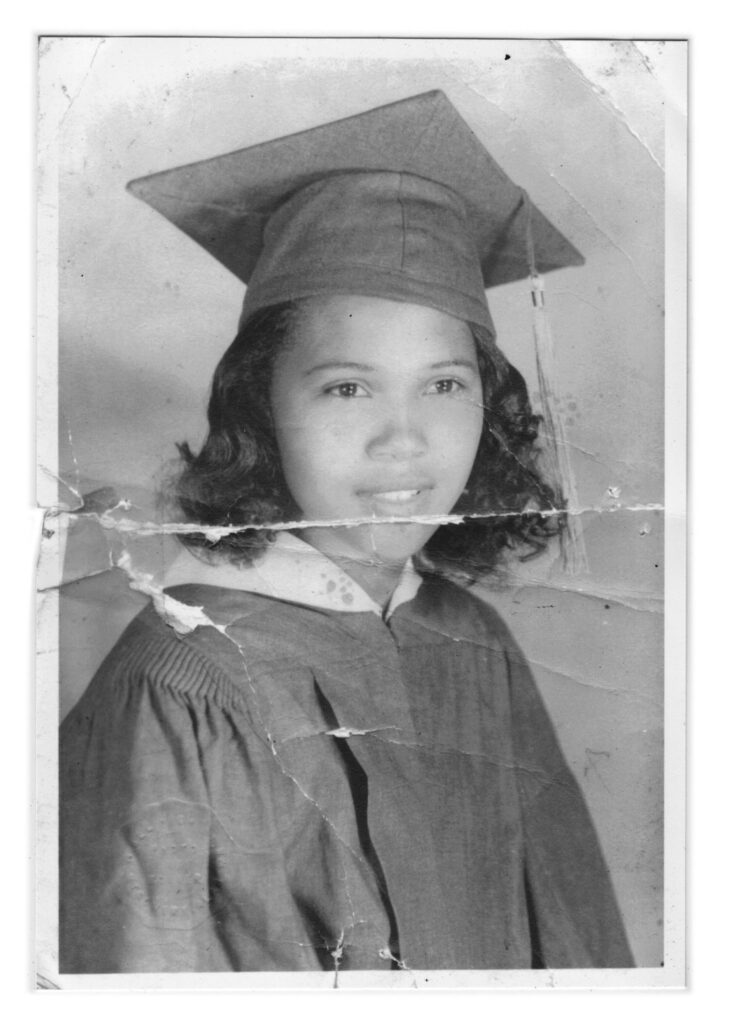
In 1951, Barbara Johns and other Black students in Prince Edward County went on strike to protest unequal school conditions. The lawsuit that grew from that protest became one of the cases ultimately decided together in Brown v. Board of Education. In 1954, the U.S. Supreme Court declared race-based school segregation unconstitutional.
Virginia’s executive branch responded with a policy known as “Massive Resistance,” championed by U.S. Senator Byrd, a former Virginia governor, conservative Democrat, and head of the powerful Byrd Organization. This involved the state closing public schools under desegregation orders and diverting public funds to segregated private schools. Schools in Charlottesville, Front Royal, and Norfolk temporarily closed rather than desegregate.
Black families and civil rights organizations continued challenging segregation in court and pushing for schools to reopen, while white parents in favor of public schools also organized against the closures. Public pressure mounted. After courts ruled school closures unconstitutional in 1959, then-Governor Almond slowly backed away from Massive Resistance. Virginia then adopted a “freedom of choice” plan, which put the responsibility onto Black students and families to petition for access to historically white schools. Even so, Prince Edward decided to close its public schools through 1964. Large-scale desegregation did not occur until 1968, when the U.S. Supreme Court ruled that the plan did not sufficiently enforce desegregation.
The decade-long fight to properly resource schools for both Black and white students made it clear that Virginia needed to better invest in its public school system. In 1966, lawmakers enacted a new statewide sales tax, with a portion of the revenue sent back to localities based on their school-aged population. This dedicated funding source marked a new state commitment to public education and remains a critical source of school funding to this day.
That new investment was important, but relying on a sales tax meant asking more of families with lower incomes. Sales taxes do not account for ability to pay. Whether you’re buying a new pair of shoes, a bar of soap, or an ice cream cone, people have to pay the same sales tax on the item, regardless of income or wealth. Discriminatory barriers to good-paying jobs, education, and wealth mean Black families are more likely to have lower incomes. As a result, many Black families contributed a larger share of their income toward sales taxes, and therefore public schools — including families whose children had been denied equal access to education.
In the same time period as school desegregation, Black Virginians continued to challenge barriers to voting. In 1963, Norfolk community activist Evelyn Butts filed a lawsuit challenging Virginia’s poll tax as an unfair financial burden that violated the 14th Amendment’s Equal Protection Clause. Her case was later combined with a similar challenge brought by Annie E. Harper and three other Black residents of Fairfax County. The 24th Amendment had recently banned poll taxes in federal elections. In 1966, the U.S. Supreme Court ruled in Harper v. Virginia State Board of Elections that a poll tax in any election was unconstitutional. When Virginia’s constitution was rewritten in 1971, poll taxes were not included.
After the Poll Tax: Fines and Fees
While the poll tax was outlawed, other parts of Virginia’s legal system continued to limit Black political power and place greater costs on Black communities. Fines and fees sit outside our traditional tax code, but they raise a similar question about who is asked to pay for public services. Rather than funding all court services through our shared resources, Virginia has long shifted some of those costs onto people who pass through the criminal legal system by imposing fines and fees, including onto people with the least ability to pay. Because policing practices subject Black people to more frequent stops, searches, and arrests, fines and fees also fall more heavily on Black communities.
This system has deep roots in discriminatory practices and continues to affect Black communities today. After the Civil War, Virginia’s criminal legal system was used to restrict Black freedom, force people into unpaid labor, and take away voting rights. Later policing and incarceration policies exposed more Black people to court fines, fees, and debt. The modern system of fines and fees has at times functioned as a “backdoor poll tax,” creating another barrier to regaining the right to vote after a felony conviction. In November 2026, voters chose to amend the state’s constitution to restore rights to people upon release from incarceration.
TCI’s Honest History: How Fines and Fees Came to Harm Black Communities in Virginia traces this history and its ongoing effects in greater detail. Together, these systems show another way choices about public funding can ask more of people and communities with fewer resources while limiting their ability to build economic and political power.
Today: An Upside-Down Tax Code and Steps Toward Fairness
Even today, Virginia has an upside-down tax code, where people with the lowest incomes pay more in taxes as a share of income than the wealthiest among us. Sales and property taxes contribute significantly to that structure. On average, people with the lowest incomes pay more in sales taxes as a share of their income, while people pay about the same share in property taxes, no matter how much they make.
Virginia does have an income tax that changes with income, but it is relatively flat. The top rate of 5.75% applies to taxable income over just $17,000. While Virginia updated its income tax brackets throughout the 20th century, the last bracket was added in 1972 and gradually raised the starting point to $17,000 by 1990. They have not changed since.
This tax structure asks more of families of color, who are more likely to have lower incomes due to discrimination, as well as historic and ongoing policy barriers. Black families make up 21% of families filing taxes in Virginia, but account for 29% of families making less than $26,500 (the lowest 20% of incomes). Similarly, Latino families make up 13% of families filing taxes in Virginia, but account for 17% of families making less than $26,500.
At the same time, when Virginia faced revenue shortfalls, lawmakers often chose to cut spending rather than raise the revenue needed to maintain public investments. Despite Black families paying more of their income in state and local taxes, those choices hit some Black communities especially hard. During the Great Recession, Virginia lawmakers cut school funding and put limits on future spending. These cuts hit school divisions with the highest poverty rates almost three times harder than divisions with the lowest poverty. Those decisions also led to support staff cuts that were four times larger in school divisions with the highest shares of students of color than in divisions with the highest shares of white students. Some of those choices continued to affect students long after the recession ended, with particular harm done to children of color in low-income families.
In recent years, after many years of advocacy, Virginia lawmakers have taken steps to make our tax code fairer. In 2022, lawmakers created Virginia’s first refundable Earned Income Tax Credit (EITC) option, implementing a recommendation from the Commission to Study Racial Inequity in Virginia Law. The refundable credit allows eligible families to receive the entire credit even if it is more than the state income tax they owe.
For Black and Latino families who are more likely to be stuck in low-paid work, refundability helps to offset state and local sales and property taxes that take up greater portions of their income. Virginia’s state legislative research group, JLARC, found that the refundable EITC, when paired with an increase in the state standard deduction, helped make the state tax code more fair.
Conclusion: Virginia Still Has Choices to Make
Taxes in Virginia are older than the country itself. From the moment Virginia set up a government, it needed revenue to fund its priorities — and we still need revenue today to fund the schools, health care, and other shared priorities our communities rely on. But the tax system would both shape and be shaped by those in power. For centuries, people with political and economic power shaped who was asked to contribute, who had a say, and how revenue was invested. And those choices were also shaped by slavery, segregation, and other systems that restricted Black freedom and political power.
Black Virginians also resisted and helped change those systems. From the diverse Readjuster movement and challenges to school segregation to the fight against the poll tax, Black Virginians organized for greater political power, fairer public investment, and changes to policies that treated Black communities unfairly.
The explicitly discriminatory tax laws of the past are gone, but their effects did not disappear. The poll tax is gone, yet fines and fees still shift some of the cost of public services onto people navigating the legal system, and in some recent years, were considered in restoring voting rights. Publicly funded schools are legally desegregated, yet school segregation by race and income still exists in practice and leads to unequal educational outcomes — despite Black families paying more sales taxes as a share of income, which are a key education funding source. And Virginia still has an upside-down tax code that overall asks more of families with the least.
Virginia can make different choices. Lawmakers can build a fairer tax structure that asks the wealthiest to pay their fair share and holds corporations accountable. They can also strengthen refundable tax credits that boost the incomes of low-income families and families of color and raise the sustainable revenue we need for schools, health care, and other shared priorities. Those investments must also recognize and address the lasting effects of policy choices that denied Black communities equal access to opportunity and public resources.
Virginia’s history shows how policy choices helped create many of the unfair outcomes we see today. But it also shows that people have organized to change those choices before. We can make choices today that help build a tax system that raises the revenue we need to invest in our communities fairly and helps everyone to thrive, no exceptions.